A Text-book of medical practice for practitioners and students / edited by William Bain.
- Date:
- 1904
Licence: In copyright
Credit: A Text-book of medical practice for practitioners and students / edited by William Bain. Source: Wellcome Collection.
Provider: This material has been provided by The University of Leeds Library. The original may be consulted at The University of Leeds Library.
56/1042 page 28
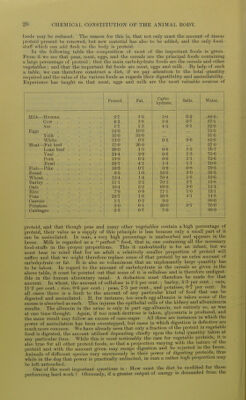
![foods nijiy be reduced. The reason for this is, that not only must the amount of tissue proteid present be renewed, but new material has also to be added, and the only food- stuff which can add flesh to the liody is ])roteid. In the following table the com]josition of most of the important foods is given. From it we see that peas, meat, eggs, and the cereals are the principal foods containing a large percentage of jjroteid ; that the main carbohydrate foods are the cereals and other vegetables ; and that the important fat foods are meat, eggs and milk. By help of such a table, we can therefore construct a diet, if we pay attention to the total quantity requh-ed and the value of the various foods as regards their digestibility and assimilability. Experience has taught us that meat, eggs and milk are the most valuable sources of Proteid. Fat. (Jaroo- hydrate. Salts. Water. iViiiK—xxumau .... 0.7 0 0 0 \j . 00 0 Cow ..... 4-2 3-8 3-8 0-7 87-5 Ass ..... 1-7 1-3 4-5 0-5 920 Eggs 14-0 100 75 0 Yolk 16-0 32-0 51-0 White .... 13-0 0-3 6-5 o-'e 85-6 Meat—Fat beef .... 17-0 26-0 57-0 Lean beef .... 20-0 1-5 b'e 1-2 7'6-7 Veal 19-4 2-9 0-8 1-3 75-6 Pork 19-9 6-2 0-6 1-1 72-6 Fowl 22-7 4-1 1-3 1-1 70-8 Fish—Pike 18-3 0-7 0-9 0-8 79-8 Bread 8-5 1-0 55-0 2-0 33-5 Wheat 12-4 1-4 70-4 1-8 13-6 Barley ...... 11-1 2-2 70-2 2-7 13-8 Oats 10-4 5-2 69-0 3-0 12-4 Rice ...... 7-9 0-9 77-1 1-0 13-1 Peas 23-7 1-6 56-8 3-1 14-8 Carrots ...... 1-1 0-2 9-0 88-0 Potatoes 2-0 0-1 20-0 0-7 76-0 Cabbages 3-3 0-7 7-0 88-0 proteid, and that though peas and many other vegetables contain a high percentage of proteid, their value as a supply of this principle is less because only a small part of it can be assimilated. In man, a very high percentage is unabsorbed and appears in the ffeces. Milk is regarded as a perfect food, that is, one containing all the necessary food-stuffs in the proper proportions. This it undoubtedly is for an infant, but we must bear in mind that for an adult a relatively smaller proportion of proteid will suffice and that we might therefore replace some of that proteid by an extra amount of carbohydi-ate or fat. It is also so voluminous that an unpleasantly large quantity has to be taken. In regard to the amount of carbohydrate in the cereals as given in the above table, it must be pointed out that some of it is cellulose and is therefore undigest- ible in the human alimentary canal. A deduction must therefore be made for that amount. In wheat, the amount of cellulose is 2-5 per cent. ; barley, 5-3 per cent. ; oats, 11-2 per cent. ; rice, O-fi per cent. ; peas, 7'5 per cent., and potatoes, 0-7 per cent. In all cases there is a limit to the amount of any particular kind of food that can be digested and assimilated. If, for instance, too much egg-albumin is taken some of the excess is absorbed as such. This injures the epithelial cells of the kidney and albuminuria results. The albumin in the urine is only in part egg-albumin, not entirely so, as was at one time thought. Again, if too much dextrose is taken, glycosuria is produced, and the same result may follow an excess of cane-sugar. All these are instances m which the power of assimilation has been overstepped, but cases in which digestion is defective are much more common. We have already seen that only a fraction of the proteid in vegetable food is digested, the amount utilised depending chiefly upon the total quantity taken at any particular time. While this is most noticeably the case for vegetable proteids, it is also true for all other proteid foods, so that a proportion varying with the nature of the proteid and with the amount given may escape digestion and be rejected in the ffeces. Animals of different species vary enormously in their power of digesting proteids, thus while in the dog that power is practically unlimited, in man a rather high proportion may be left untouched. . , j-ji j r 4.1, One of the most important questions is : How must the diet be modihed tor those performing hard work ? Obviously, if a greater output of energy is demanded from the](https://iiif.wellcomecollection.org/image/b21510167_0056.jp2/full/800%2C/0/default.jpg)