The diaphragm in man : a record of our present knowledge of its development, relationships, structure, and mode of action / by J.F. Halls Dally.
- Dally, John Frederick Halls, 1877-1944.
- Date:
- [1908?]
Licence: In copyright
Credit: The diaphragm in man : a record of our present knowledge of its development, relationships, structure, and mode of action / by J.F. Halls Dally. Source: Wellcome Collection.
Provider: This material has been provided by The Royal College of Surgeons of England. The original may be consulted at The Royal College of Surgeons of England.
46/58 page 204
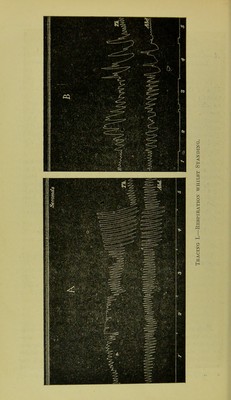
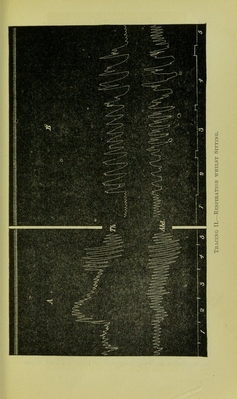
![movements of the tliorax, although usually proportional, do not vary directly \yith those of the diaphragm. Although the force^ of the respiration varies, the frequency of contraction remains much the same. The thorax can carry on the whole of respiration when the diaphragm is motionless, as in paralysis of the diaphragm, and both it and the abdominal muscles can function independently of the thorax. This is exemplified in a case of spinal disease recorded by Hilton (®’), and in spar- teine-poisoning Cushny and Matthews have found that the muscles of the thorax and abdomen contract whilst the diaphragm is paralysed. In A and B I. we find the abdominal excursion in quiet breathing greater in amplitude than the thoracic, which latter exhibits a species of dicrotism, ])robably muscular, showing that expiration takes place in two stages and is not absolutely continuous, together with tiny undulations which may be due to the blood-pressure. The “dicrotism’ becomes more marked in B 2, but the lesser waves disappear. In A and B 3, thoracic inspiration proceeds rapidly until the diaphragm has attained its maximum contraction, and then expiratory undulations with subsequent rapid fall obtain, more marked in B 3. The diaphragmatic expiration is not continu- ous, but occurs in two main stages. In B 4 the amplitude of the curves is marked, the first half of the upward rise is gradual, and represents the contraction of the diaphragm, the second half is sudden and caused bv the contraction of the %/ abdominal muscles (absent in A). The two phases are syn- chronous, for the diaphragm begins to contract before the thorax has ceased to expire. When respiration returns to the ordinary, the thoracic excursion at times exceeds the abdo- minal (B, I., 5), thus instancing how, within a brief interval of time, change of type can occur. Again in B, II., 3, contrac- tion of the diaphragm happens before the thorax has finished expiring, and the diaphragmatic and abdominal portions of the inspiratory wave are well seen in B, II., 4. The most marked variations occur in B, III. Following tranquil breathing, upper costal respiration is suddenly brought into action, accompanied by slight corresponding increase in the abdominal movement A and B, 2. Not infrequently the abdomen goes on expiring after the thorax, e.g. B, II., and a line drawn so as to join the summits of the inspiratory curves is seen to be approximately straight, showing correspondence between thoracic and abdo- minal movements at the end of inspiration, whilst aline joining the lowest points of the expiratory curves is irregular. For the sake of simplicity it is convenient to regard the diaphragm in respiration as being composed of three portions, a central](https://iiif.wellcomecollection.org/image/b22419226_0048.jp2/full/800%2C/0/default.jpg)