Genetics, environment and psychopathology / editors, Sarnoff A. Mednick [and others].
- Date:
- 1974
Licence: Attribution-NonCommercial 4.0 International (CC BY-NC 4.0)
Credit: Genetics, environment and psychopathology / editors, Sarnoff A. Mednick [and others]. Source: Wellcome Collection.
55/364 page 39
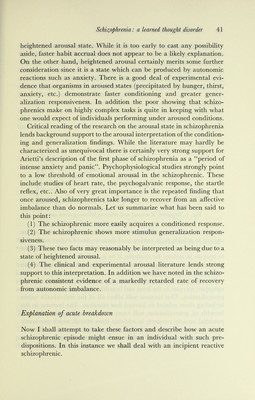
![SCHIZOPHRENIA: A LEARNED THOUGHT DISORDER* SARNOFF A. MEDNICK From the great variety of deviance, peculiarity, and debasement which presented itself to Bleuler, that aspect of his schizophrenic patients which most arrested his attention was their disturbance of sequential associative thought. Perhaps this is the aspect of the disorder which for centuries has set its victims apart from the rest of humanity. But from one point of view it is not surprising that people manifest such a dis¬ order; what is surprising is that more of us do not. After all (assuming random sampling) at any given point in thought the probability of the development of a reasonable sequence of ideas is astronomically small. Let me assure you that I never allow myself to dwell too long on this threatening associative sequence for fear that I'll suffer the fate of the centipede who found himself unable to walk when he began to study the synchrony of his hundred legs. However let it suffice if I make the point that rational thought is a narrow and improbable path. This afternoon I shall discuss the thought and behavior of individuals who have strayed from this narrow path. On the basis of conditioning and psychophysiological research and clinical experience I am going to suggest that the origin of the schizo¬ phrenic disorder lies in the interaction of hypersensitive autonomic nervous systems and unkind environments. In the context of behavior theory (mainly learning theory) I will first try to reconstruct how an individual may have an acute breakdown. I will then explain the transition from the acute state to the chronic state. [. . .] * This paper was first presented to the XIV Congress of Applied Psychology which was held in Copenhagen during 1961. It was subsequently included in Volume 4 of the Proceedings of the XIV International Congress of Applied Psychology edited by G. S. Nielsen, and published by Munksgaard International during 1962. 39](https://iiif.wellcomecollection.org/image/b18032618_0056.JP2/full/800%2C/0/default.jpg)