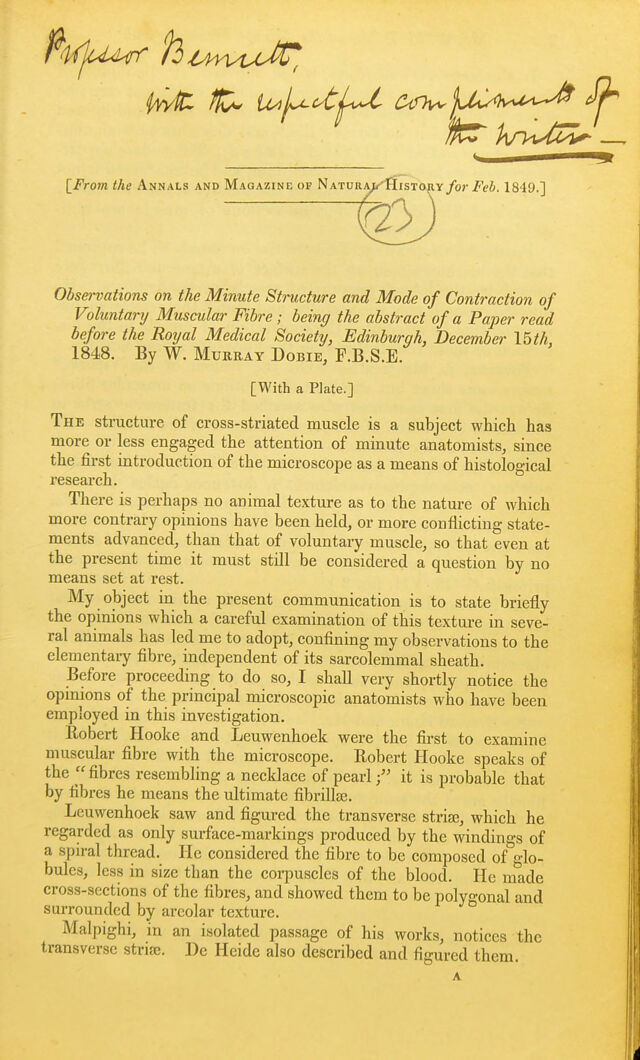
Observations on the minute structure and mode of contraction of voluntary muscular fibre : being the abstract of a paper read before the Royal Medical Society, Edinburgh, December 15th, 1848 / by W. Murray Dobie.
- Dobie, William M. (William Murray), 1828-1915.
- Date:
- [1849]
Licence: Public Domain Mark
Credit: Observations on the minute structure and mode of contraction of voluntary muscular fibre : being the abstract of a paper read before the Royal Medical Society, Edinburgh, December 15th, 1848 / by W. Murray Dobie. Source: Wellcome Collection.
Provider: This material has been provided by The University of Glasgow Library. The original may be consulted at The University of Glasgow Library.
5/18 page 3
![Mr. Skcy, in a paper in the ' Philosophical Transactions/ sets forth as his opinion, that each muscular fibre is a tube, contain- ing in its interior a semi-transparent amorphous substance; the tube he supposes to be composed of fibrilljE, and the transverse strise to be depressions on the surface of the fibre. The views of Miiller, Schwann, Lauth and Henle are very similar to those advanced by Fontana. Schwann considers the fibrillse to be beaded filaments, pre- senting under the microscope a succession of dark points sepa- rated by light and somewhat narrower portions of the fibril. Dr. Martin Barry holds the structure of muscle to be s])iral; he says each fibril is composed of two spirals coiling in opposite directions. From these observers I shall pass to those who in recent times have examined the fibrillse of muscle, with a view to determinnig the real constitution of these filaments. The publication of Mr. Bowman's paper in the ' Philosophical Transactions' was an sera in the microscopy of muscle, though he does not seem to have been able to make out the ultimate con- stitution of the fibrillse, which he considered -warn- composed of a series of highly refracting particles of one kind; he thus describes them:— Fibrillse present alternate dark and light points when the part is a little out of focus. The light parts are the centres of highly refracting particles acting as lenses; the dark points the intervals between them. If now the focus be carefully adjusted and the achromatic condenser be used for the purpose of defining the outline with the utmost precision, each dai'k interspace be- tween the refracting points will be found to be reduced to two very slender straight lines, crossing the fibrillse in a transverse du-ection, and giving the light spaces as now seen a rectangular figui-e. (Fig. 3 a b.) Dr. Sharpey, from an examination of Mr. Lealand^s prepara- tions of the muscle of pig, considers the sarcal particles each to be composed of a dark central and clear outer part. Dr. Sharpey mentions that Mr. Lealand himself first pointed out a cross line in the clear interval, and also the bright surrounding areas (fig. ^ahb). Dr. Carpenter examining the same dissections comes to a similar conclusion (fig. 2 b). Professor Allen Thomson of Glasgow, in his late work on Phy- siology, describes the structure of the fibrillse in the same way as Dr. Sharpey : but since the pubhcation of that work he has been led to doubt the existence of any lateral clear edge, as he himself has informed me. A 2](https://iiif.wellcomecollection.org/image/b21470790_0005.jp2/full/800%2C/0/default.jpg)