Content advisory
This digitised material is free to access, but contains information or visuals that may:
- include personal details of living individuals
- be upsetting or distressing
- be explicit or graphic
- include objects and images of objects decontextualised in a way that is offensive to the originating culture.
Licence: In copyright
Credit: [Franklin and Gosling]. Source: Wellcome Collection.
3/11
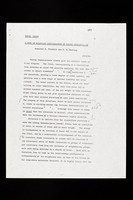
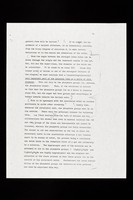
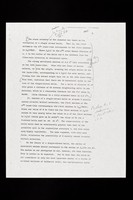
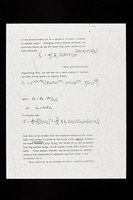
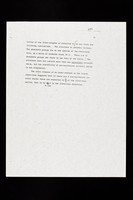
![tf-f^ fj' The above estimât^of 20A diameter was baaed on t he assumption of a single strand helix. That is, the first maximxnon the n fc h layer-line corresponds to the first maximum in J n (21TrR). Where J n (u) is the n th order Bessel Function of u, r is the radius of the. helix and R the distance from the fibre-axi3 direction in reciprocal space. The 3trong meridional maximum at 3.4 A 0 lies accurately on the 10thflayer-line. From this new lines of maxima eminate, as from : the origin, crossing the origin series on the 5th layer- liÀe, corresponding to a Js(u) for each series, con firming that the second origin does lie on .the 10th layer-line. ^Thia then, indicates that there are 10 structural units in one ' turn of the single-strand helix. For a helix of diameter 20 A° thia gives a distance of 6A between neighbouring units in one molecule, which is a reasonable distance for the P-P value in_ NaDNA. (this distance in a fully extended chain is 6.8 A 0 ]I.J If, instead of a aingle-3trand helix we propose 2 equally spaced co-axial helical molecules, the first maximum on the n fch layer-line corresponds to the first maximum in J, Since our value of R is fixed and the fir3t maximum in Jg(x) occurs at very nearly twice the value in x of the first maximum in Ji(x) (which gave us, 2r s^20A°) the value of 2r for a 2-atrand helix must be 40-A 0 . The cross-section of the helix would then be considerably greater than that of the primitive cell in the crystalline structure A, and this would seem highly improbable. The same argument, with even more force, eliminates the possibility of 3 equally spaced co-axial helical molecules. On the theory of a single-strand helix, the series of equatorial maxima should correspond to the maxima of J 0 (4iir sin 6). The maxima on our photograph do not, however, fit this function. This is rather to be expected. For we know that the helix so far considered is only the most important member of a series of co-axial heliciea of different radii, the non-phosphates parts / a- ■ ( 2îCrR). y , Û I L t](https://iiif.wellcomecollection.org/image/b18172040_PP_CRI_H_1_42_7_0003.jp2/full/800%2C/0/default.jpg)