A treatise on the venereal disease / by John Hunter ; with copious additions, by Philip Ricord ; translated and edited, with notes, by Freeman J. Bumstead.
- John Hunter
- Date:
- 1859
Licence: Public Domain Mark
Credit: A treatise on the venereal disease / by John Hunter ; with copious additions, by Philip Ricord ; translated and edited, with notes, by Freeman J. Bumstead. Source: Wellcome Collection.
Provider: This material has been provided by the National Library of Medicine (U.S.), through the Medical Heritage Library. The original may be consulted at the National Library of Medicine (U.S.)
134/592
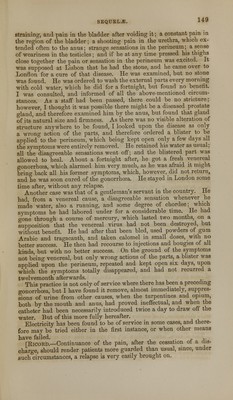
![matter altering, are no proofs that the poison is destroyed. It is no more necessary that there should be a continuance of the inflammation to produce the specific poison than that there should be a continuance of the inflammation to produce the gleet, as will appear evident from two cases before related.1 The first of these cases shows that the inflammation is not necessary to the existence of the venereal poison; and, on the contrary, the inflammation may exist after the matter discharged has ceased to be venereal. I have known cases where the inflammation and discharge have continued for twelve months, and with considerable violence; in the mean time a free intercourse with women has not communicated the disease. However, this is not an absolute proof that there is no virus in the discharge. [Ricord.—A distinction between gonorrhoea and gleet, which Hun- ter would establish, is far from being admitted, in the same sense, by all writers on venereal. As has been seen, Hunter, believing gonorrhoea virulent, thinks the principal difference between it and gleet, laying aside the greater mildness of the symptoms in the latter, consists in the entire absence of any virus in true gleet; but the reasons which he gives are far from convincing himself of the justness of this distinction. The presence or absence of a contagious property, can lead to no decided conclusion on this point. Gleet is to gonorrhoea what the chronic stage, in inflammations in general, is to the acute stage. A virulent cause has no more to do with one than with the other; there is only a difference of intensity in the morbid state, whence result differences in the symptoms, and especially in the secretion, which is more or less purulent in the acute stage, and more or less mucous in the chronic. By thus subjecting gleet to the general laws of catarrhal inflamma- tions, we can explain, without any need of hypotheses, its liability to aggravations, to intermissions, and to fresh attacks. We discover a reason for the contagious or innocuous character of the morbid secre- tion, without being forced to admit the presence or absence of a virus. And whilst we emerge from the uncertainty in which Hunter leaves us, as well as if we adopt the rational doctrine of B. Bell, we arrive at the certain conclusion, that the more purulent the secretion is, the more it may act as a contagious principle, in #virtue of its irritant properties; and that, on the contrary, it has no effect when it passes into the mucous stage. It is evident that a running, which has be- come innocuous, as last supposed, may become again contagious, on returning to the acute stage; and we can thus account for those cases which Hunter vainly endeavors to explain, and for the too guarded opinion of Wathely, who believes that a purely mucous discharge is still contagious.] 1 Vide pages 76 and 77.](https://iiif.wellcomecollection.org/image/b21131521_0134.jp2/full/800%2C/0/default.jpg)