The microscopic organisms found in the blood of man and animals, and their relation to disease / By Timothy Richards Lewis.
- Timothy Richards Lewis
- Date:
- 1879
Licence: Public Domain Mark
Credit: The microscopic organisms found in the blood of man and animals, and their relation to disease / By Timothy Richards Lewis. Source: Wellcome Collection.
Provider: This material has been provided by London School of Hygiene & Tropical Medicine Library & Archives Service. The original may be consulted at London School of Hygiene & Tropical Medicine Library & Archives Service.
21/118 page 11
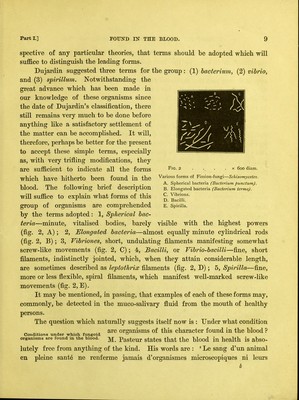
![they do not accumulate to any great extent therein, and it may be safely affirmed that their presence in appreciable numbers is, judging from experience, incom- patible with a state of perfect health. It will hereafter be seen that the same remark does not hold good as regards parasites of, apparently, animal nature. It may be affirmed, further, that in certain diseased conditions micro- phytes are very generally present, though perhaps The diseases m which fission-fungi 1 ^ 1/0 «'■'■ o r r have been found in the biood. n0^ inVariably, nor is their number co-incident with the gravity of the malady. Omitting the cases in which these organ- isms have been found associated with disease in insects (on account of the difficulty of isolating and clearly identifying such organisms as are found in the blood in these cases, from those found in the tissues generally), it may be stated that it has been clearly established that one or other of the forms of fission-fungi have been found in the blood in two diseases, viz., in charbon, mat de rate or splenic fever ; and in recurrent fever. M. Pasteur has recently maintained that a third should be added to the list—septicemia ; and, still more recently, a fourth has been added by Dr. Klein, namely, the disease commonly known as ' typhoid-fever' of the pig. These matters have, during the last few years, received great attention from thoughtful members of the medical profession, and probably at the present time no subject of a scientific character is being more closely investigated. The importance of thoroughly sifting the evidence on which the interpreta- tions which have been placed on the significance of The fermentation theories of the 1 0 causation of disease. suc]1 organisms in the blood can scarcely be over- rated, seeing that, should the views now commonly advanced prove to be correct, the theory and practice of medicine would be radically affected, and, possibly, the future action of the State with regard to disease be materially modified. Before making an attempt to institute such an examination, it may be well to refer briefly to the more salient circumstances which have conduced to make the present doctrine of the causative relation to disease of these low forms of plant- life so attractive to botanists and to the medical profession. ' The foundations of the germ theory of disease in its most commonly accepted form,' writes Dr. Charlton Bastian,1 ' were laid in 1836 and shortly afterwards. The discovery at this time of the yeast-plant by Schwann and Cagniard-Latour soon led to the 1 Paper read before the Pathological Society of Loudon, April Cth, 1875. Lancet, vol. i, page 501, 1875. Britith Medical Journal, vol. i, page 469, 1875.](https://iiif.wellcomecollection.org/image/b2136414x_0021.jp2/full/800%2C/0/default.jpg)