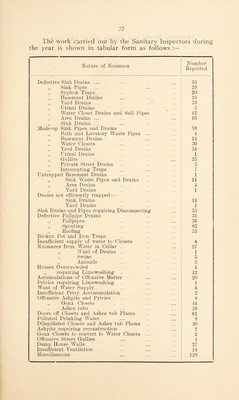
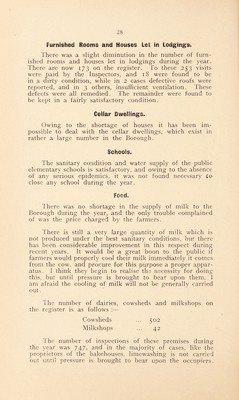
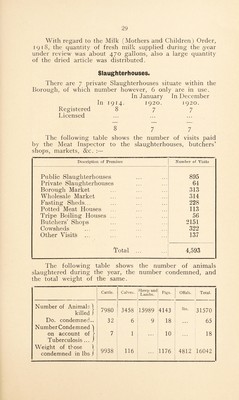
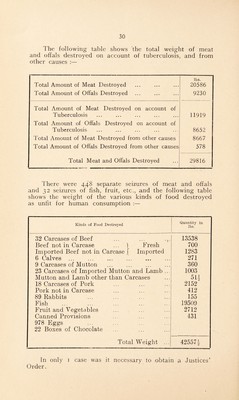
[Report 1920] / Medical Officer of Health, Halifax County Borough.
- Halifax (England). County Borough Council. nb2008024085.
- Date:
- 1920
Licence: Attribution 4.0 International (CC BY 4.0)
Credit: [Report 1920] / Medical Officer of Health, Halifax County Borough. Source: Wellcome Collection.
36/56 (page 32)
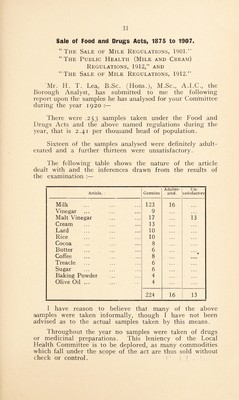
![In my opinion insufficient attention is also paid to sweetmeats, arsenic may find its way in through the use of inferior sugar, while talc and other mineral matters of an objectionable nature are used to give polish or in- crease the weight. 139 samples of Milk were examined, 16 of these were below the standard fixed by The Sale of Milk Regulations 1901, or 1 1.5 per cent, of the samples taken. There is no excuse whatever for this large percentage of adulterated milks, as the standard of milk in the Borough is high and compares very favourably with that of many large towns. There were four cases in which legal proceedings were instituted ; in the first case a milk dealer was fined £2 including costs, for selling a m]ilk with 9 per cent, of added water ; in the second case a farmer ,was prose- cuted on two counts, one added wateir to the extent of 22 per cent, and one added water to the extent of 1 1 per cent., the latter was dismissed owing to the ‘ small- ness ’ of the deficiency, and the former was also dismissed because the analyst spent too long a time over the analysis, Thursday mid - day to the following Monday morning ; surely any comment on these extraordinary verdicts are unnecessary. In a third case a farmer was alleged to have added ten per cent, of water to his milk, this case was also dismissed. When the fourth case of a farmer adding 1 1, 20 and 7 per cent, of water to milk wajs heard and again dismissed, The Local Authority decided to appeal. The appeal was heard in London during March this year and sent back to the magistrates to convict. A penalty of £1 and costs was imposed. Other cases during the year were dealt with by the Medical Officer who wrote to the offenders. 39 types of Vinegar were sampled during the year ; of these 9 were bought as “ vinegar ” and proved to be artificial vinegar of correct strength, i.e., above 4 per cent. Acetic Acid content. 13 of the remaining samples were unsatisfactory, as the purchaser asked for Malt Vinegar but received artificial vinegar. In five cases, proceedings were instituted, and in each, judgment was given in favour of the plaintiff with costs. In my opinion the vendors of unbrewed vinegars should be compelled to declare the quality of the article to would-be purchasers. The remaining samples of butter, cream, coffee, sugars, etc., were of good quality and complied in every respect with The Sale of Food and Drugs Acts.](https://iiif.wellcomecollection.org/image/b29406195_0036.jp2/full/800%2C/0/default.jpg)