Copy 1, Volume 1
Cosmos, a sketch of a physical description of the universe / By Alexander von Humboldt ; translated from the German, by E.C. Otté [B.H. Paul and W.S. Dallas].
- Alexander von Humboldt
- Date:
- 1849
Licence: Public Domain Mark
Credit: Cosmos, a sketch of a physical description of the universe / By Alexander von Humboldt ; translated from the German, by E.C. Otté [B.H. Paul and W.S. Dallas]. Source: Wellcome Collection.
418/462 (page 10)
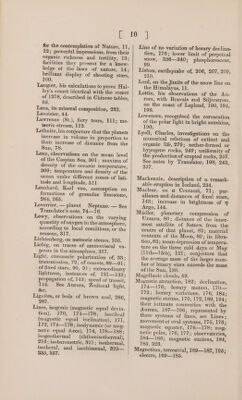
![[ for the contemplation of Nature, 11, 12; powerful impressions, from their organic richness and fertility, 13; facilities they present for a know- ledge of the laws of nature, 14; brilliant display of shooting stars, 100. Laugier, his calculations to prove Hal- ley’s comet identical with the comet of 1378, described in Chinese tables, 95. Lava, its mineral composition, 232. Lavoisier, 44. Lawrence (St.), fiery tears, 111; me- teoric stream, 112. Leibnitz, his conjecture that the planets increase in volume in proportion to their increase of distance from the Sun, 78. Lenz, observations on the mean level of the Caspian Sea, 301; maxima of density of the oceanic temperature, 309; temperature and density of the ocean under different zones of lati- tude and longitude, 311 Leonhard, Karl yon, assumption on formations of granular limestone, 264, 265. Leverrier, — planet Neptune. — See Translator’s note, 74—76. Lewy, observations on the varying quantity of oxygen in the atmosphere, according to local conditions, or the seasons, 317. Lichtenberg, on meteoric stones, 105. Liebig, on traces of ammoniacal va- pours in the atmosphere, 317. Light, chromatic polarization of, 33; transmission, 72; of comets, 89—91; of fixed stars, 90, 91; extraordinary lightness, instances of, 131—133; propagation of, 143; speed of transit, 144. See Aurora, Zodiacal] light, &c. Lignites, or beds of brown coal, 286, 287. Lines, isogonic (magnetic equal devia- tion), 170, 174—178; isoclinal (magnetic equal inelination), FAL, 172, 174—178; isodynamic (or mag- netic equal force), 174, 178—188; isogeothermal (chthonisothermal), 216; isobarometrie, 321; isothermal, isotheral, and isochimenal, 323— 335, 367. Line of no variation of horary declina- tion, 176; lower limit of perpetual snow, 336—340; phosphorescent, 99 Lisbon, earthquake of, 206, 207, 209, 210. Lord, on the Jimits of the snow line on the Himalayas, 11. Lottin, his observations of the Au- rora, with Bravais and Siljerstrom, on the coast of Lapland, 190, 194, 196. Lowenorn, recognised the coruscation of the polar light in bright sunshine, 190. Lyell, Charles, investigations on the numerical relations of extinct and organic life, 279; nether-formed or hypogene rocks, 249; uniformity of the production of erupted rocks, 257. See notes by Translator, 198, 248, 257. Mackenzie, description of a remark- able eruption in Iceland, 234. Maclear, on a Centauri, 71 3 par- allaxes and distances of fixed stars, 143; increase in brightness of 7 Argo, 144. Madler, planetary compression of Uranus, 80; distance of the inner- most satellite of Saturn from the centre of that planet, 82; material contents of the Moon, 80; its libra- tion, 83; mean depression of tem pera- ture on the three cold days of May (11th—13th), 121; conjecture that the average mass of the larger num- ber of binary stars exceeds the mass of the Sun, 139. Magellanic clouds, 69. Magnetic attraction, 182; declination, 174—176; horary motion, 170— 172; horary variations, 176, 184; magnetic storms, 170, 172, 189, 194; their intimate connection with the Aurora, 187—196; represented by three systems of lines, see Lines ; movement of oval systems, 175, 176; magnetic equator, 176—178; mag- netic poles, 176, 177; observatories, 184— 186; magnetic stations, 184, 185, 323. Magnetism, terrestrial, 169—187, 195; electro, 169—185.](https://iiif.wellcomecollection.org/image/b29328895_0001_0418.jp2/full/800%2C/0/default.jpg)