Handbook of materia medica, pharmacy, and therapeutics, including the physiological action of drugs, the special therapeutics of disease, official and practical pharmacy, and minute directions for prescription writing / by Sam'l O.L. Potter.
- Samuel Otway Lewis Potter
- Date:
- 1894
Licence: Public Domain Mark
Credit: Handbook of materia medica, pharmacy, and therapeutics, including the physiological action of drugs, the special therapeutics of disease, official and practical pharmacy, and minute directions for prescription writing / by Sam'l O.L. Potter. Source: Wellcome Collection.
Provider: This material has been provided by Royal College of Physicians, London. The original may be consulted at Royal College of Physicians, London.
755/846 page 753
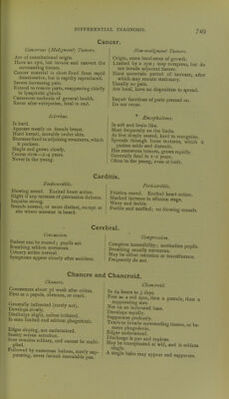
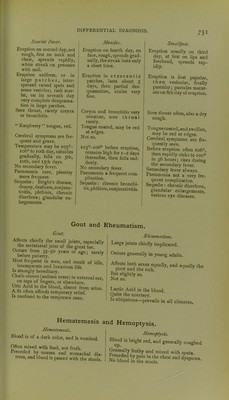
![TEMPERATURE IN DISEASE. Yellow and Bilious Fevers. Yellow Fever. Duration short, ends in 3-7 days. Incubation 5-9 days. A disease of one paroxysm, terminating in recovery or collapse. Very severe nausea and vomiting, early epigastric tenderness. Black vomit, due to gastric hemorrhage. Hemorrhages from various parts. Tongue clean, or slightly coated. Pulse variable, slow at end. Eye injected and humid. Supra-orbital pain, pain in back and in calves of leg. Rarely delirious, mind clear generally. Urine albuminous, usually suppressed. Convalescence rapid, no sequelae. Muscular prostration slight. Mortality high, disease epidemic. Treatment unsatisfactory. Autopsy: inflamed or congested stomach, enlarged yellow liver, filled with oil globules, muscular fibres of heart are often disintegrated. Bilious Remitteni. Lasts 9 days or more. Incubation may extend to months. A disease of several paroxysms, with inter- vening remissions. These symptoms are not so severe nor do they occur so early. Bilious vomiting. No hemorrhagic tendency. Tongue heavily coated. Pulse quick until convalescence. Eye natural. Headache, sense of fullness in head, often no loin or leg pains. Delirium frequent, mind dull. Not so. Convalescence slow, tedious sequelre. Muscular prostration greater. Mortality slight, disease endemic. Very amenable to treatment. Autopsy: stomach congested, rarely in- flamed, liver olive or bronze hue. not fatty. Vomiting. Cerebral. Little or no nausea, vomiting continues after stomach is emptied. No tenderness or pressure over the liver or stomach. Pulse infrequent and hard. Tongue clean, breath sweet, conjunctivas normal or injected, and headache primary. Constipation generally obstinate. No salivation. Gaslric or Hepatic. Nausea relieved by discharge, returns when food IS taken. Liver and stomach are tender, pressure pro- duces inclination to vomit. Pulse frequent and weak. Tongue furred, breath offensive, conjunc- tivas often yellowish, and headache sec- ondary as to time. Griping abdominal pain, diarrhoea and clay-colored stools. Increased salivation. temperature in disease. Average Normal Temperature, of adults nS tt • .-u'u aged, 98.8°. Diurnal variation 1° to i c® t ‘^dren, 99 ; of the Above 108° F. is a fatal siim ^-.highest from 9 a. m. to 2 p. m. by ice from 96° to about 60® F. (A) Thrclinicarthe^ mouth, axilla or rectum, and retained i thermometer placed in the in hand with Aconite in the treatment of infla ^ go hand see the articles Fever, ^ <?)• Antipyretics on page 43.] m part III, also the list of these agents The thermometer shouM *L°self-registe^[^^^ positive diagnosis, according to the Fahrenheit scale. ^The nost reH^hl accurately marked the rectum or vagina; less so - the axilla anVSlVslT^Tnrstilut^^^^^^](https://iiif.wellcomecollection.org/image/b24907297_0755.jp2/full/800%2C/0/default.jpg)



 No text description is available for this image
 No text description is available for this image
 No text description is available for this image