Alcohol and the human body : an introduction to the study of the subject, and a contribution to national health / by Sir Victor Horsley and Mary D. Sturge, with a chapter by Arthur Newsholme.
- Victor Horsley
- Date:
- 1911
Licence: In copyright
Credit: Alcohol and the human body : an introduction to the study of the subject, and a contribution to national health / by Sir Victor Horsley and Mary D. Sturge, with a chapter by Arthur Newsholme. Source: Wellcome Collection.
320/334 (page 282)
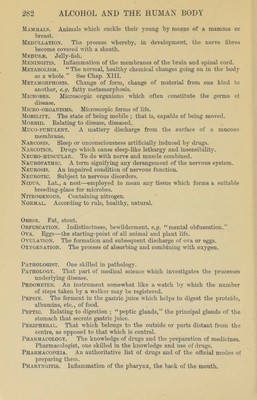
![Mammals. AnimaLs which suckle their young by means of a mamma or breast. Meuullation. Tlie ])rocess whereby, in development, the nerve fibres become covered w’ith a sheath. Medus.®. Jelly-fish. Meningitis. Inflammation of the membranes of the brain and spinal cord. Metabolism. “ The normal, healthy chemical changes going on in the body as a whole. ” See Chap. XIII. Metamorphosis. Change of form, change of material from one kind to another, e.q. fatty metamorphosis. Microbes. Microscopic organisms which often constitute the germs ot disease. Micro-organisms. Microscopic forms of life. Mobility. The state of being mobile ; that is, capable of being moved. Morbid. Eelating to disease, diseased. Muco-purulent. a mattery discharge from the surface of a mucous membrane. Narcosis. Sleep or unconsciousness artificially induced by drugs. Narcotics. Drugs which cause sleep-like lethargy and insensibility. Neuro-mdscular. To do with nerve and muscle combined. Neuropathic. A term signifying any derangement of the nervous system. Neurosis. An impaired condition of nervous function. Neurotic. Subject to nervous disorders. Nidus. Lat., a nest—employed to mean any tissue w'hich forms a suitable breeding-place for microbes. Nitrogenous. Containing nitrogen. Normal. According to rule, healthy, natural. Obese. Fat, stout. Obfuscation. Indistinctness, bewilderment, e.g. “mental obfuscation.” Ova. Eggs—the starting-point of all animal and plant life. Ovulation. The formation and subsequent discharge of ova or eggs. Oxygenation. The process of absorbing and combining with oxygen. Pathologist. One .skilled in pathologj. Pathology. That part of medical science which investigates the processes underlying disease. Pedometer. An instrument somewhat like a watch by which the number of steps taken by a walker may be registered. Pepsin. The ferment in the gastric juice which helps to digest the proteids, albumins, etc., of food. Peptic. Relating to digestion ; “peptic glands,” the principal glands of the stomach that secrete gastric juice. Peripheral. That w'hich belongs to the outside or parts distant from the centre, as opposed to that which is central. Pharmacology. The knowledge of drugs and the preparation of medicines. Pharmacologist, one skilled in the knowledge and use of drugs. Pharmacopceia. An authoritative list of drugs and of the olficial modes of preparing them. Pharyngitis. Inflammation of the pharynx, the back of the mouth.](https://iiif.wellcomecollection.org/image/b2901072x_0320.jp2/full/800%2C/0/default.jpg)