Alcohol and the human body : an introduction to the study of the subject, and a contribution to national health / by Sir Victor Horsley and Mary D. Sturge, with a chapter by Arthur Newsholme.
- Victor Horsley
- Date:
- 1911
Licence: In copyright
Credit: Alcohol and the human body : an introduction to the study of the subject, and a contribution to national health / by Sir Victor Horsley and Mary D. Sturge, with a chapter by Arthur Newsholme. Source: Wellcome Collection.
321/334 (page 283)
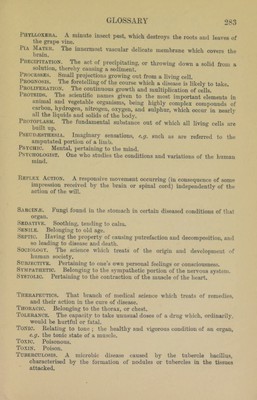
![I'HTLLOXEUA. A minute insect pest, which destroys the roots and leaves of the grape vine. PlA Mater. The innermost vascular delicate membrane which covers the brain. Precipitation. The act of precipitating, or throwing down a solid from a solution, therebj' causing a sediment. Processes. Small projections growing out from a living cell. Prognosis. Tlie foretelling of the course which a disease is likely to take. Proliferation. The continuous growth and multiplication of cells. PROTEIDS. The scientific name.s given to the most important elements in animal and vegetable organisms, being highly complex compounds of carbon, hydrogen, nitrogen, oxygen, and sulphur, which occur in nearlv all the liquids and .solids of the body. Protoplasm. Tlie fundamental substance out of which all living cells are built up. Pseod^thesia. Imaginary sensations, e.g. such as are referred to the amputated portion of a limb. Psychic. Mental, pertaining to the mind. Psychologist. One who studies the conditions and variations of the human mind. Reflex Action. A responsive movement occurring (in consequence of some impre.ssion received by the brain or spinal cord) independently of the action of the will. Sarcinac. Fungi found in the stomach in certain diseased conditions of that organ. Sedative. Soothing, tending to calnu Senile. Belonging to old age. Septic. Having the property of causing putrefaction and decomposition, and so leading to disease and death. Sociology. The science which treats of the origin and development of human society. Subjective. Pertaining to one’s own ]>ersoDal feelings or consciousness. Sympathetic. Belonging to the sympathetic portion of the nervous system. Systolic. Pertaining to the contraction of the muscle of the heart. Therapeutics. That branch of medical science which treat.s of remedies, and their action in the cure of ilisease. Thoracic. Belonging to the thorax, or chest. Tolerance. The capacity to take unusual doses of a drug which, ordinarily, would be hurtful or fatal. Tonic. Relating to tone ; the healthy and vigorous condition of an organ, e.g. the tonic state of a muscle. Toxic. Poisonous. Toxin. Poison. Tuberculosis. A microbic di.sease caused by the tubercle bacillus, characterised by the formation of nodules or tubercles in the tissues attacked.](https://iiif.wellcomecollection.org/image/b2901072x_0321.jp2/full/800%2C/0/default.jpg)