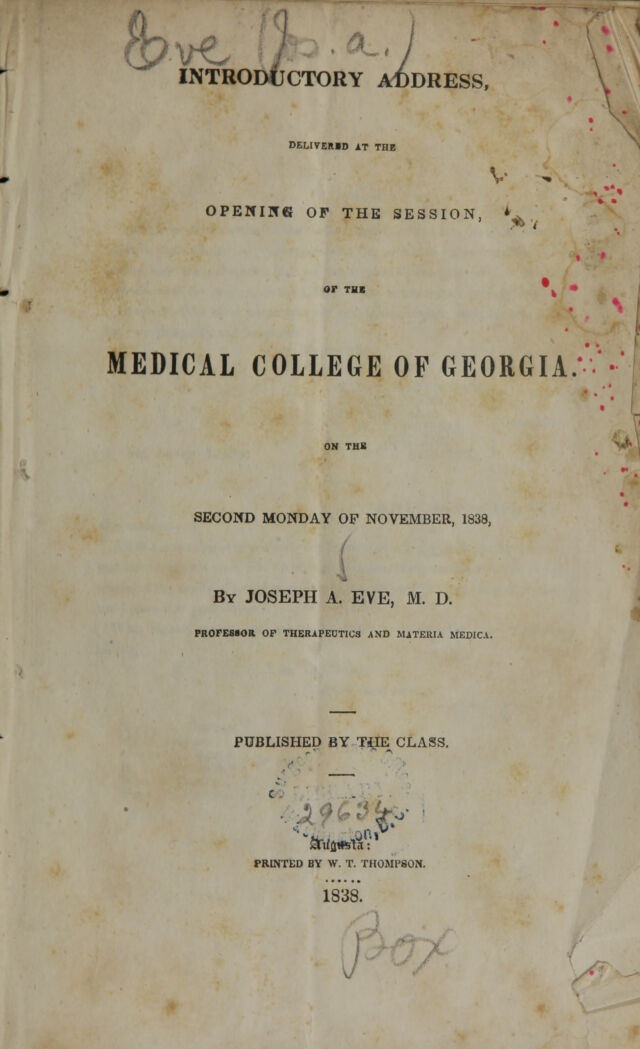
Introductory address, delivered at the opening of the session of the Medical College of Georgia : on the second Monday of November, 1838 / by Joseph A. Eve.
- Eve, Joseph A. (Joseph Adams), 1805-1886
- Date:
- 1838
Licence: Public Domain Mark
Credit: Introductory address, delivered at the opening of the session of the Medical College of Georgia : on the second Monday of November, 1838 / by Joseph A. Eve. Source: Wellcome Collection.
Provider: This material has been provided by the National Library of Medicine (U.S.), through the Medical Heritage Library. The original may be consulted at the National Library of Medicine (U.S.)
13/24
![[13] philosophy, which have been the glory of his own, and the ad- miration of all succeeding ages ;—but to recount all the good results that have flowed from the same source, would be to detail the history of the arts and sciences for the last two hundred years. It was not until comparitively late, that physicians have become properly impressed with the importance of the inductive philoso- phy; hence, whilst the other sciences flourished, medicine lan- guished : and it is only, since its cultivators have adopted the principles of this philosophy, and sought truth by induction, that medicine has witnessed such rapid improvements and justi- fied its claims to rank, among the certain sciences: and may it not be said with truth, that more has been accomplished, that medicine has made greater advances toward perfection, in the nineteenth century, than previously, in the long lapse of ages since the days of Hippocrates? It would be an interesting task to trace the beneficial effects of this philosophy upon the medical sciences, but time will per- mit us only to refer, very generally, to some of them. Chemistry which, before the days of Bacon, appeared to have an elective attraction for all that was absurd and extrava- gant in other parts of knowledge, first felt the meliorating influ- ence of the principles he taught, principles which have divested it of all its wildness, extravagance and romance, and elevated it to the state of a certain science—a science which has not only reflected the most important benefits on medicine, but one of most extensive and varied usefulness to mankind: these princi- ples have indeed rendered chemistry one of the most accurate and exalted of the sciences, and thus contributed most to enlarge the sphere of human knowledge, and extend man's empire over the physical world. This philosophy has been no less successful in its application](https://iiif.wellcomecollection.org/image/b21118358_0013.jp2/full/800%2C/0/default.jpg)

 No text description is available for this image
 No text description is available for this image
 No text description is available for this image