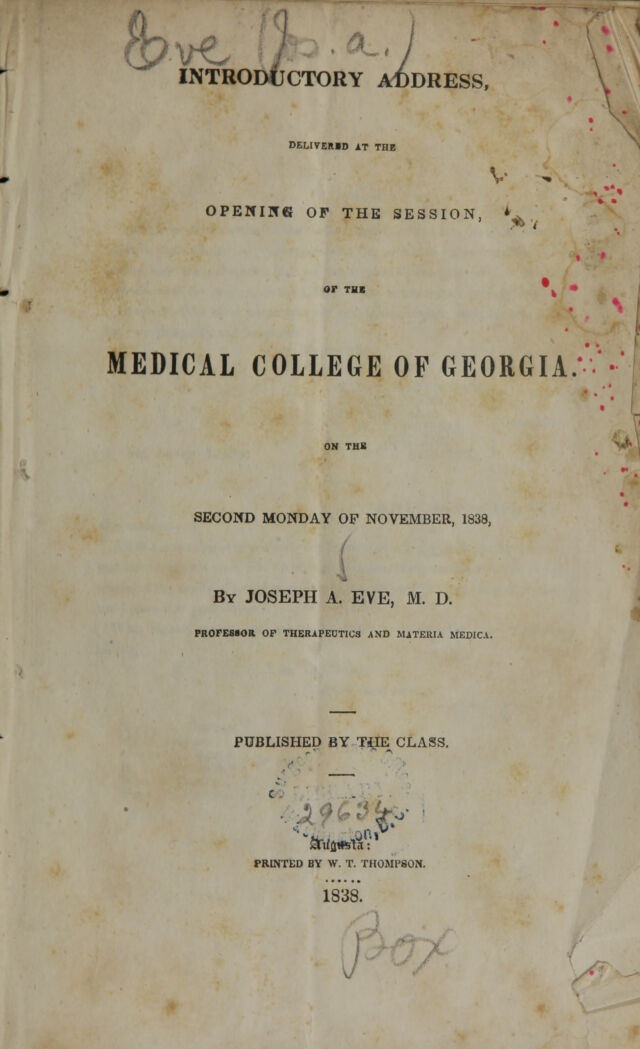
Introductory address, delivered at the opening of the session of the Medical College of Georgia : on the second Monday of November, 1838 / by Joseph A. Eve.
- Eve, Joseph A. (Joseph Adams), 1805-1886
- Date:
- 1838
Licence: Public Domain Mark
Credit: Introductory address, delivered at the opening of the session of the Medical College of Georgia : on the second Monday of November, 1838 / by Joseph A. Eve. Source: Wellcome Collection.
Provider: This material has been provided by the National Library of Medicine (U.S.), through the Medical Heritage Library. The original may be consulted at the National Library of Medicine (U.S.)
18/24
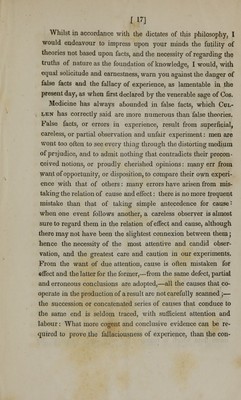
![113] stant reference that is made to it, as an infallible proof of the suc- cess of the most opposite and incongruous modes of practice 7 To prevent error and obviate danger, the most rigid principles of a sound and discriminating philosophy are continually re- quired. Every attempt to exaggerate the importance of principles over facts.or of facts over principles, is alike unphilosopliical and ab- surd—it is equal to the folly of contending for the superior im- portance of the base or superstructure, in architecture, as though both were not equally essential to the construction of the ed- ifice. Principles or theories without facts for their foundation, like air-built castles, exist only in the minds of visionary dreamers ; and facts, without principles, are as materials ready lor the build- er's use, but require his skill and labour to collocate and, bind them together, in the erection of a fabric symmetrical, beauti- ful and harmonious in all its parts. Should we build facts upon facts, (says Rush,) until our pile reached the heavens, they would tumble to pieces, unless they were cemented by principles. Medicine without princi- ples is an humble art, and a degrading occupation. It reduces a physician to a level with the cook and the nurse, who admin- ister to the appetites and weakness oi the people, but directed by principles, it imparts the highest elevation to the intellectual and moral character of man. In medicine, all knowledge is either demonstrative or inferen- tial—that is, it is either demonstrable to the senses, or it must be inferred or deduced by the mind from facts which are objects of sense. Let your attention be engaged now in laying a good foundation in positive facts, that you may have substantial pre- mises from which to reason: Let your study be principally](https://iiif.wellcomecollection.org/image/b21118358_0018.jp2/full/800%2C/0/default.jpg)

 No text description is available for this image
 No text description is available for this image
 No text description is available for this image