[Report 1946] / Medical Officer of Health, Ramsgate Borough.
- Ramsgate (England). Borough Council.
- Date:
- 1946
Licence: Attribution 4.0 International (CC BY 4.0)
Credit: [Report 1946] / Medical Officer of Health, Ramsgate Borough. Source: Wellcome Collection.
5/28 (page 3)
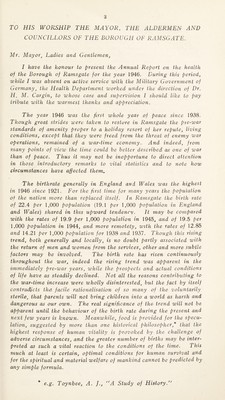
![TO HIS WORSHIP THE MAYOR, THE ALDERMEN AND COUNCILLORS OF THE BOROUGH OF RAMSGATE. Mr. Mayor} Ladies and Gentlemen, I have the honour to present the Annual Report on the health of the Borough of Ramsgate for the year 1946. During this period, while I was absent on active service with the Military Government of Germany, the Health Department worked under the direction of Dr. H. M. Car gin, to whose care and supervision I should like to pay tribute, with the warmest thanks and appreciation. The year 1946 was the first whole year of peace since 1938. Though great strides were taken to restore in Ramsgate the pre-war standards of amenity proper to a holiday resort of her repute, living conditions, except that they were freed from the threat of enemy war operations\, remained of a war-time economy. And indeed, from many points of view the time could be better described as one of war than of peace. Thus it may not be inopportune to direct attention in those introductory remarks to vital statistics and to note how circumstances have affected them. The birthrate generally in England and Wales was the highest in 1946 since 1921. For the first time for many years the population of the nation more than replaced itself. In Ramsgate the birth rate of 22A per 1,000 population (19.1 per 1,000 population in England and Wales) shared in this upward tendency. It may be compared with the rates of 19.9 per 1,000 population in 1945, and of 19.5 per I, 000 population in 1944, and more remotely, with the rates of 12.85 and 14.21 per 1,000 population for 1938 and 1937. Though this rising trend, both generally and locally, is no doubt partly associated with the return of men and women from the services, other and more subtle factors may be involved. The birth rate has risen continuously throughout the war, indeed the rising trend was apparent in the immediately pre-war years, while the prospects and actual conditions of life have as steadily declined. Not all the reasons contributing to the war-time increase were wholly disinterested, but the fact by itself contradicts th& facile rationalisation of so many of the voluntarily sterile, that parents will not bring children into a world as harsh and dangerous as our own. The real significance of the trend will not be apparent until the behaviour of the birth rate during the present and next few years is known. Meanwhile, food is provided for the specu¬ lation, suggested by more than one historical philosopher * that the highest response of human vitality is provoked by the challenge of adverse circumstances, and the greater number of births may be inter¬ preted as such a vital reaction to the conditions of the time. This much at least is certain, optimal conditions for human survival and for the spiritual and material welfare of mankind cannot be predicted by any simple formula. * e.g. Toynbee, A. ]., “A Study of History/J](https://iiif.wellcomecollection.org/image/b30029053_0005.jp2/full/800%2C/0/default.jpg)