Letter addressed to the members of the House of Commons on poor law medical relief : with a proposed Bill and commentary &c, &c / by Richard Griffin.
- Griffin, Richard, 1806-1869.
- Date:
- [1866]
Licence: Public Domain Mark
Credit: Letter addressed to the members of the House of Commons on poor law medical relief : with a proposed Bill and commentary &c, &c / by Richard Griffin. Source: Wellcome Collection.
22/54 page 20
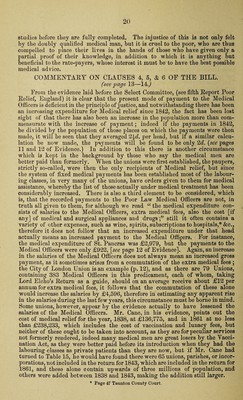
![studies before they are fully completed. The injustice of this is not only felt by the doubly qualified medical man, but it is cruel to the poor, who are thus compelled to place their lives in the hands of those who have given only a partial proof of their knowledge, in addition to which it is anything but beneficial to the rate-payers, whose interest it must be to have the best possible medical advice. COMMEUTABY OY CLAUSES 4, 5, & 6 OE THE BILL. (see page 13—14.) From the evidence laid before the Select Committee, (see fifth Beport Poor Belief, England) it is clear that the present mode of payment to the Medical Officers is deficient in the principle of justice, and notwithstanding there has been an increasing expenditure for Medical relief since 1842, the fact has been lost sight of that there has also been an increase in the population more than com¬ mensurate with the increase of payment; indeed if the payments in 1842, be divided by the population of those places on which the payments were then made, it will be seen that they averaged 2\d. per head, but if a similar calcu¬ lation be now made, the payments will be found to be only 2d. (see pages 11 and 12 of Evidence.) In addition to this there is another circumstance which is kept in the background by those who say the medical men are better paid than formerly. When the unions were first established, the paupers, strictly so-called, were then the only recipients of Medical relief, but since the system of fixed medical payments has been established most of the labour¬ ing classes, in very many of the unions, have orders given to them for medical assistance, whereby the list of those actually under medical treatment has been considerably increased. There is also a third element to be considered, which is, that the recorded payments to the Poor Law Medical Officers are not, in truth all given to them, for although we read “ the medical expenditure con¬ sists of salaries to the Medical Officers, extra medical fees, also the cost [if any] of medical and surgical appliances and drugs still it often contains a variety of other expenses, such as wine, spirits, subscriptions to hospitals,* &c., therefore it does not follow that an increased expenditure under that head actually means an increased payment to the Medical Officers. For instance, the medical expenditure of St. Pancras was £2,979, but tlhe payments to the Medical Officers were only £922, [see page 12 of Evidence]. Again, an increase in the salaries of the Medical Officers does not always mean an increased gross payment, as it sometimes arises from a commutation of the extra medical fees ; the City of London Union is an example (p. 12), and as there are 79 Unions, containing 383 Medical Officers in this predicament, each of whom, taking Lord Elcho’s Beturn as a guide, should on an average receive about £12 per annum for extra medical fees, it follows that the commutation of these alone would increase the salaries by £4,596, therefore in estimating any apparent rise in the salaries during tbe last few years, this circumstance must be borne in mind. Some unions, however, appear by the evidence actually to have lessened the salaries of the Medical Officers. Mr. Cane, in his evidence, points out the cost of medical relief for the year, 1838, at £136,775, and in 1861 at no less than £238,233, which includes the cost of vaccination and lunacy fees, but neither of these ought to be taken into account, as they are for peculiar services not formerly rendered, indeed many medical men are great losers by the Vacci¬ nation Act, as they were better paid before its introduction when they had the labouring classes as private patients than they are now, but if Mr. Cane had turned to Table 15, he would have found there were 65 unions, parishes, or incor¬ porations, not included in the return for 1843, which are included in the return for 1861, and these alone contain upwards of three millions of population, and others were added between 1838 and 1843, making the addition still larger. * Page 47 Taunton County Court.](https://iiif.wellcomecollection.org/image/b30567804_0022.jp2/full/800%2C/0/default.jpg)
 No text description is available for this image
 No text description is available for this image
 No text description is available for this image