Rest and pain : a course of lectures on the influence of mechanical and physiological rest in the treatment of accidents and surgical diseases, and the diagnostic value of pain / by the late John Hilton ; edited by W.H.A. Jacobson.
- John Hilton
- Date:
- 1896
Licence: Public Domain Mark
Credit: Rest and pain : a course of lectures on the influence of mechanical and physiological rest in the treatment of accidents and surgical diseases, and the diagnostic value of pain / by the late John Hilton ; edited by W.H.A. Jacobson. Source: Wellcome Collection.
36/538 page 16
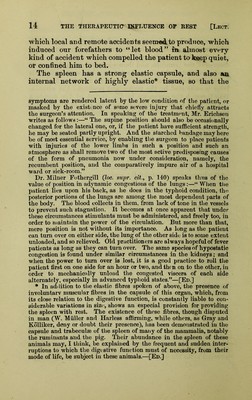
![of the reasons for the existence of a third lobe in the right lung; and it is worthy of this additi onal remark, that this third lobe is wedge-shaped, a mechanical form seldota employed in the constmction of the human body. This wedge-force is the most pov\ erful mechanical force which can be employed; and, being interposed between the upper and lower lobe, is competent to separate them from emh other, and from the middle mediastinum containing the heart, &c.* race for food or from an eater, an animal with such a muscular band l>assing directly across the cavity of its right ventricle must possess is not a difficult thing for any man to understand who has ever either watched in another or experienced in himselt the distress caused b}/ the over-distension of any muscular sac,’’—[I n.] * Prof. Rolleston, in his address to the Brit Med. Association at Oxford in the Long Vacation of 1868, wrote of the “ Law of Parsimony ” or “Economy” (Newton’s enunciation of this law runs in part as follows:—“ Natura nihil agit frustra ; et frnstra fit per plura quod fieri potest per pauciora. Natura enim simplex est, et remm causis snperfluis non luxuriat—”):—“ Where does Nature bind herself to the observance of a ‘ Law of Parsimony ’ ? In, as I think, three distinct lines of lier operations. “Where an organ can be diverted from one and set to discliarge another function, there Nature will spare herself the expense of forming a new organ, will adapt the old one to a new use. She is prodigal in the variety of her adaptations. She is niggard in the invention of new structures (Milne-Edwards, cit. in Darwin’s Origin of Species, p. 232). The complicated arrangement of co-operating muscles, whereby the bird’s third eyelid is drawn across to moisten and wipe its eyeball with- out undue pressure on the optic nerve, is manufactured, if we may so express ourselves, out of the suspensorius muscle, which in other animals has but the function of slinging up the eye. The scarcely less complex and beautiful arrangement of the bird’s levator humeri is the result of a modification of a subclavius muscle. “ Secondly, where, by availing herself of the inorganic forces always at work, or where by the employment of—as in what is called ‘ Histological Substitution ’—a lowly organized or vitalized tissue, such as elastic tissue, she can spare herself the manufacture of such expensive structures as muscle, there Nature adopts a line of practice which we call a Law of Parsimony. Where a suspensory muscle for the eye can be dispensed with altogether, as where there is a more or less closed bony orbit, as in ourselves, and an air-tight cavity formed by it, together with the soft tissues lining it, there atmospheric pressure is trusted to steady the eye in the socket, as it refixes the tooth loosened by inflammation, and holds the head of the femur in the acetabulum. The eye of the burrowing mole, on the other hand, loses its recti and obliqui before it verges itself into total extinction ; but this very suspensorius it retains](https://iiif.wellcomecollection.org/image/b28136718_0036.jp2/full/800%2C/0/default.jpg)




 No text description is available for this image
 No text description is available for this image
 No text description is available for this image