Rest and pain : a course of lectures on the influence of mechanical and physiological rest in the treatment of accidents and surgical diseases, and the diagnostic value of pain / by the late John Hilton ; edited by W.H.A. Jacobson.
- John Hilton
- Date:
- 1896
Licence: Public Domain Mark
Credit: Rest and pain : a course of lectures on the influence of mechanical and physiological rest in the treatment of accidents and surgical diseases, and the diagnostic value of pain / by the late John Hilton ; edited by W.H.A. Jacobson. Source: Wellcome Collection.
57/538 page 37
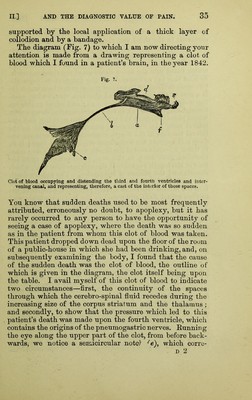
![of blood, which was quite entire, will also establish the fact of the continuity of these various parts, through which, as I have undertaken to suggest to you, the cerebro-spinal fluid passes to and fro, according to the state of congestion of the interior of the brain. I might here remark, that it appears to me impossible that any patient can live with what is called a diffused external hydrocephalus, assuming that the external hydro- cephalic fluid is placed within the external arachnoid. As the brain is of a greater specific gravity than the hydro- cephalic fluid, it would of necess ty sink upon the internal base of the skull, or if it did not sink from its own weight, it would be compelled to do so by the hydrocephalic fluid swimming over the top of the brain, and thus pressing the brain upon the base of the skull. You will remember that the arteries of the brain contain the blood, through the medium of which the brain is nourished and manifests its functions; that those arteries lie between the under surface of the brain and the bones of the skull, and if this hydro- cephalic fluid press the brain downwards, it must compress the blood-vessels between itself and the bones of the skull, and in that way the supply of blood to the brain would be cut off. So again, if the base of the brain were thus pressed downwards, the pneumogastric nerves would also be compressed, and the respiration would cease. Now it has never fallen to my lot to see a case of diffused—mark, I say diffused—external hydrocephalus, and, therefore, I presume the cases must be rare.* I apprehend that the rigid tubes of nervous matter, burst, and extravasated their contents into the substance of the medulla. One of these haemorrhages took place just on the outside of tlie left vagal nucleus, which was thereby stimulated; and as the vagus is the cardio-inhibitory nerve, the heart was stopped instantly, hence the suddenness of the death, and also the absence of lividity, for death did not take place from stop- page of respiration, but from sudden cessation of the heart.”—[Ed.] * The only condition to which this term can rightly be applied, is where a gradual passive exudation of fluid takes place into the sub- arachnoid space, accompanying and telling of the atrophy of the brain beneath, the hydrocephalus ex vacuo of older writers, met witli after long wasting diseases, or in senile decay, whether timely or premature, as in the ease of Dean Swift; this form of hydrocephalus having been met with in the case of the great satirist, and forming one of the causes of that death which he so much dreaded, viz. a decay of the mind](https://iiif.wellcomecollection.org/image/b28136718_0057.jp2/full/800%2C/0/default.jpg)


 No text description is available for this image
 No text description is available for this image
 No text description is available for this image