State board questions and answers / by R. Max Goepp.
- Goepp, R. Max (Rudolph Max), 1866-1950
- Date:
- 1911
Licence: Public Domain Mark
Credit: State board questions and answers / by R. Max Goepp. Source: Wellcome Collection.
Provider: This material has been provided by the Francis A. Countway Library of Medicine, through the Medical Heritage Library. The original may be consulted at the Francis A. Countway Library of Medicine, Harvard Medical School.
79/744 page 73
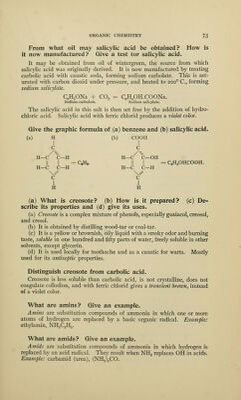
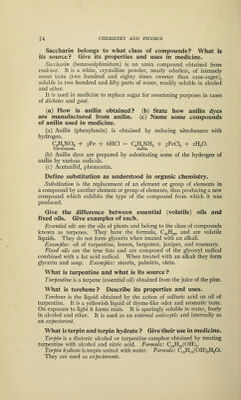
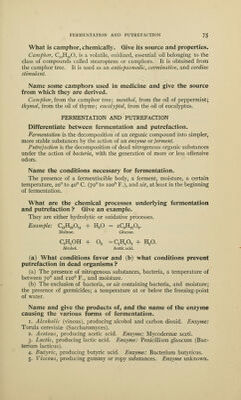
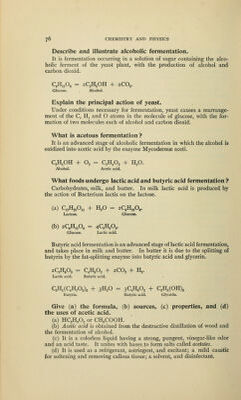
![From what oil may salicylic acid be obtained? How is it now manufactured? Give a test tor salicylic acid. It may be obtained from oil of wintergreen, the source from which salicylic acid was originally derived. It is now manufactured by treating carbolic acid with caustic soda, forming sodium carbolate. This is sat- urated with carbon dioxid under pressure, and heated to 2000 C, forming sodium salicylate. C6H5ONa + C02 = C6H4OH.COONa. Sodium carbolate. Sodium salicylate. The salicylic acid in this salt is then set free by the addition of hydro- chloric acid. Salicylic acid with ferric chlorid produces a violet color. Give the graphic formula of (a) benzene and (b) salicylic acid. (a) H (b) COOH C C /% /.% H—C C—H H—C C—OH I] I ^QHe. |] I = C6H4OHCOOH. H—C C—H H—C C—H \// \s c c I I H H (a) What is creosote? (b) How is it prepared? (c) De= scribe its properties and (d) give its uses. (a) Creosote is a complex mixture of phenols, especially guaiacol, creosol, and cresol. (b) It is obtained by distilling wood-tar or coal-tar. (c) It is a yellow or brownish, oily liquid with a smoky odor and burning taste, soluble in one hundred and fifty parts of water, freely soluble in other solvents, except glycerin. (d) It is used locally for toothache and as a caustic for warts. Mostly used for its antiseptic properties. Distinguish creosote from carbolic acid. Creosote is less soluble than carbolic acid, is not crystalline, does not coagulate collodion, and with ferric chlorid gives a transient brown, instead of a violet color. What are amins? Give an example. Amins are substitution compounds of ammonia in which one or more atoms of hydrogen are replaced by a basic organic radical. Example: ethylamin, NH^QHg. What are amids? Give an example. Amids are substitution compounds of ammonia in which hydrogen is replaced by an acid radical. They result when NHj replaces OH in acids. Example: carbamid (urea), (NH2)2CO.](https://iiif.wellcomecollection.org/image/b21173709_0079.jp2/full/800%2C/0/default.jpg)