Pagan & Christian creeds : their origin and meaning / by Edward Carpenter.
- Edward Carpenter
- Date:
- [1920]
Licence: In copyright
Credit: Pagan & Christian creeds : their origin and meaning / by Edward Carpenter. Source: Wellcome Collection.
62/330 page 58
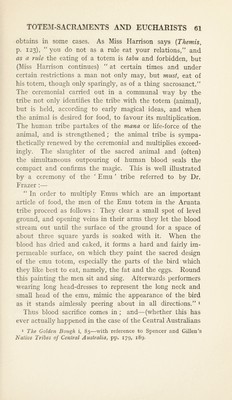
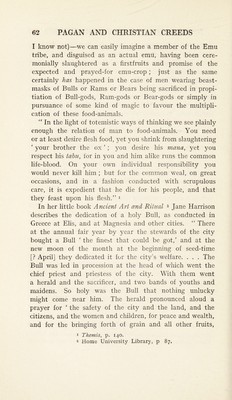
![the relation in each particular case. But I shall return to this subject presently, and more than once, v/ith the view of clarifying it. Just now it will be best to illustrate the nature of Totems generally, and in some detail. As would be gathered from what I have just said, there is found among all the more primitive peoples, and in all parts of the world, an immense variety of totem-names. The Dinkas, for instance, are a rather intelligent well- grown people inhabiting the upper reaches of the Nile in the vicinity of the great swamps. According to Dr. Seligman their clans have for totems the lion, the ele¬ phant, the crocodile, the hippopotamus, the fox, and the hyaena, as well as certain birds which infest and damage the corn, some plants and trees, and such things as rain, fire, etc. Each clan speaks of its totem as its ancestor, and refrains [as a rule] from injuring or eating it.’’ ^ The members of the Crocodile clan call themselves “ brothers of the crocodile.” The tribes of Bechuana-land have a very similar list of totem-names—the buffalo, the fish, the porcupine, the wild vine, etc. They too have a Crocodile clan, but they call the crocodile their father ! The tribes of Australia much the same again, with the differences suitable to their country ; and the Red Indians of North America the same. Garcilasso della Vega, the Spanish historian, son of an Inca princess by one of the Spanish conquerors of Peru and author of the well-known book Commentarias Reales, says in that book (i, 75), speak¬ ing of the pre-Inca period, “ An Indian (of Peru) was not considered honorable unless he was descended from a fountain, river or lake, or even from the sea, or from a wild animal, as a bear, lion, tiger, eagle, or the bird they call cuntur (condor), or some other bird of prey.” 2 According * See The Golden Bough, vol. iv, p. 31. 3 See Andrew Lang, Custom and Myth, p. 104, also Myth, Ritual and Religion, vol. i, pp. 71, 76, etc.](https://iiif.wellcomecollection.org/image/b29980161_0062.jp2/full/800%2C/0/default.jpg)
 No text description is available for this image
 No text description is available for this image
 No text description is available for this image