An American text-book of surgery : for practitioners and students / By Phineas S. Conner, M.D., Frederic S. Dennis, M.D., William W. Keen, M.D., Charles B. Nancrede, M.D., Roswell Park, M.D., Lewis S. Pilcher, M.D., Nicholas Senn, M.D., Francis J. Shepherd, M.D., Lewis A. Stimson, M.D., J. Collins Warren, M.D., and J. William White, M.D. Ed. by William W. Keen and J. William White.
- William Williams Keen
- Date:
- 1899
Licence: Public Domain Mark
Credit: An American text-book of surgery : for practitioners and students / By Phineas S. Conner, M.D., Frederic S. Dennis, M.D., William W. Keen, M.D., Charles B. Nancrede, M.D., Roswell Park, M.D., Lewis S. Pilcher, M.D., Nicholas Senn, M.D., Francis J. Shepherd, M.D., Lewis A. Stimson, M.D., J. Collins Warren, M.D., and J. William White, M.D. Ed. by William W. Keen and J. William White. Source: Wellcome Collection.
Provider: This material has been provided by the Augustus C. Long Health Sciences Library at Columbia University and Columbia University Libraries/Information Services, through the Medical Heritage Library. The original may be consulted at the the Augustus C. Long Health Sciences Library at Columbia University and Columbia University.
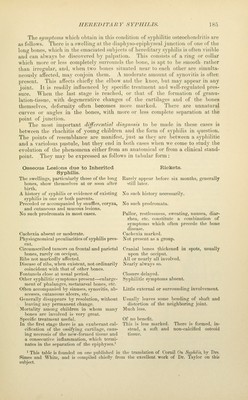
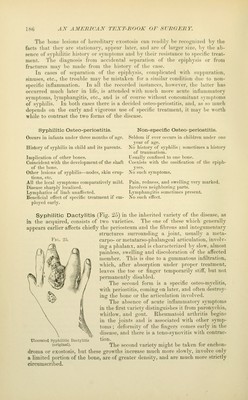
![Syphilitic Osteitis. Tubercular Osteitis. Histoloj^ically, consists of a rolutivcly large Made up of a varying nuiiil)cr of tu])crcle- mass of granulation-tissue. granulations ami surrounded by isolated granules. In the majority of eases can be cured, or at We know of nothing sliort of ojx'rativc in- least arrested, if taken in time, by judi- terferenee which materially affects the cious speeilic treatment. course of this disease. Syphilitic dactylitis occurs at various periods of tlio disease, and in two varieties. One of these aj)j)ears usually in the hite seeonchiry stage, and involves eliieliy the ])eriosteuni and the fibrous and integumentary tissues surrounding a joint. It is characterized by slow, almost painless, swelling and discoloration of the affected member. This is due to a gummatous infiltration, which, upon subsiding, leaves tlie fiiiger or toe temporarily stif!, but not perm an en t ly d i sa b 1 cd. The second form is a specific osteo-myelitis Avitli accompanying inilammation of the periosteum, and appears from five to fifteen years after the infection with syphilis. It is chiefly limited to the bones and periosteum, the integu- ment being but seldom involved; erosion of the articular cartilages often takes place; the ligaments and the capsule become thickened, and the function of the joint is sometimes entirely lost. The absence of acute symptoms in the subcutaneous variety enables us to diagnosticate it from paronychia, Avhitlow, and gout, l^heumatoid arthritis begins in the joints, is associated with other sjnnptoms, deformity of the fingers comes on early in the disease, and the sheaths of the tendons are involved. The second variety might be taken for enchondroma or exostosis, but these swellings involve only a limited portion of the bone, increase very slowly, and present dense, circumscribed tumors. Syphilis of the Nervous System.—The dura mater is frequently the seat of tertiary syphilis, chiefly owing to its intimate connection with the cranial bones, toward which it bears the relation of a periosteal lining. The internal surface of this membrane, in contact with the pia mater and m ith the surface of the brain, is frequently attacked at the same time—an accident which manifests itself by various cerebral symi)toras: intense cephalalgia, trembling, dulness, intellectual torpor, loss of memory, and coma. Besides these peri-encephalic lesions, the pia mater, and even the brain- substance and the spinal cord, may be the seat of sclerosis or of gummata. The pia mater presents two varieties of lesions: A chronic inflammation, followed by fibrous thickening and by adhesions to the surface of the brain ; and gummata, lesions much more characteristic than the foregoing. Cerebral gummata may be found in two forms: 1st. As large gummatous masses developed on the surface of the brain within the convolutions and in the gray substance or encroaching upon the white substance, and usually attacking the base, the cerebral peduncles, the pons Varolii, and the optic tract. They are also found upon the cerebellum and upon the superior surface of the cere])nnn. 2d. In the form of smaller nodules accompanying the cerel)ral arteries, and in particular the middle cerebral arteries. These two varieties of syphilitic lesions do not differ materially as regards their structure; their evolution is slightly different. The latter are generally accompanied by endarteritis, which results in a limited anemic softening of the brain. Symptoms of Cerebral Syphilis.—The symptoms depending upon the](https://iiif.wellcomecollection.org/image/b21217014_0206.jp2/full/800%2C/0/default.jpg)