An American text-book of surgery : for practitioners and students / By Phineas S. Conner, M.D., Frederic S. Dennis, M.D., William W. Keen, M.D., Charles B. Nancrede, M.D., Roswell Park, M.D., Lewis S. Pilcher, M.D., Nicholas Senn, M.D., Francis J. Shepherd, M.D., Lewis A. Stimson, M.D., J. Collins Warren, M.D., and J. William White, M.D. Ed. by William W. Keen and J. William White.
- William Williams Keen
- Date:
- 1899
Licence: Public Domain Mark
Credit: An American text-book of surgery : for practitioners and students / By Phineas S. Conner, M.D., Frederic S. Dennis, M.D., William W. Keen, M.D., Charles B. Nancrede, M.D., Roswell Park, M.D., Lewis S. Pilcher, M.D., Nicholas Senn, M.D., Francis J. Shepherd, M.D., Lewis A. Stimson, M.D., J. Collins Warren, M.D., and J. William White, M.D. Ed. by William W. Keen and J. William White. Source: Wellcome Collection.
Provider: This material has been provided by the Augustus C. Long Health Sciences Library at Columbia University and Columbia University Libraries/Information Services, through the Medical Heritage Library. The original may be consulted at the the Augustus C. Long Health Sciences Library at Columbia University and Columbia University.
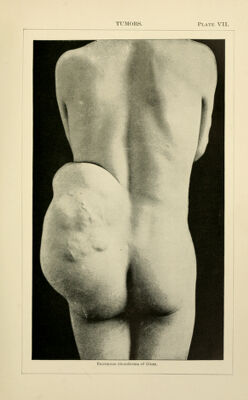
![the fingers or tors ; the lower jiixta-opipliysoal region of the femur ; tlie upj)er ends of the tibia, fibuhi, and humerus, the seapuhi and ilium, on or in tlie jaw.s, especially the upper; the salivary glands, notal)ly the parotid : the testicle ; in or arouixl joints attacked by rheuniatoiil arthritis; and the subcutaneous tissues. Diagnosis.—This must depend on the hardness yet elasticity of the tumor, its nodular circumscribed outlines, and its slow continuous growth; later, on the development of softened spots indicative of cystic degeneration, and on the location of the tinnor, as upon a young bone near an epiphysis. A carti- laginous sarcoma—the growth with which chondromata are most likely to be confounded—presents less definite outlines—/, e. infiltrates somewhat, is apt to be of unequal consistence from the outset, and grows with much greater rapidity. Treatment.—Complete removal of a pure chondronui will secure future immunity, and should always be adopted when possible. Mixed chondromata containing sarcomatous elements commonly recur. In the ])arotid gland and sub- cutaneous tissues they can usually be enucleated with their capsules, and some- times this can be done when the phalanges are involved, but more often in the latter event and when the testicle is attacked the whole part or organ must be sacrificed : usually those springing from the surfaces of the larger bones can be removed without sacrificing the bone, with but small chance of their recurrence. 4. Osseous Tumors, or Osteomata, are formed of true bone, and are gene- rally composed almost solely of either cancellous or compact bone. The can- cellous have been just described as resulting from the ossification of chondro- matous growths springing from the juxta-epiphyseal portions of such long bones as the tibia, femur, humerus, fibula, etc., Avhere they form exostoses. The ungual surface of the distal phalanx of the great toe is often the site of such a tumor, producing a subungual growth. The compact osseous tumors rarely grow from any other bones than those of the cranium. Certain exostoses, called from their hardness ivory exostoses, are said to differ from other bony growths by the absence of Haversian canals, and are composed of layers of bone lamelh>2 laid concentrically over a central point or pedicle, They rarely attain a greater size than that of a small walnut, are so dense that they can hardly be cut by any instrument, and it is difiicult by the exercise of great force to fracture their pedicles, even when comparatively slender. The ivory exostosis sprintrs from the exterior of one of the cranial bones, while the more ordinary forms of compact osteomata origniate m the cranial or nasal smuses, grow slowly, and thrust aside or cause absorption of adjacent structures, thus pro- ducing marked deformities. Although usually single, osseous tumors in some patients may be multiple, being found by the score, in such cases commonly commencing at a very early age, being then hereditary and often symmetrical. Seats of Predilection.—These have been mentioned above in describ- ing these growths. Diagnosis.—This is usually easy, depending on the evident connection of the tumor with bone or cartilage, for tumors growing apart from these struc- tures in the connective tissue are probably tumors of some other class which have undergone osseous change, or are structures, such as tendons, muscles, etc., which have undergone calcification or ossification. The jjcdunculated form when the osteoma occurs as an exostosis, the dense, hard, irregularly nodulated surface when the tumor is non-pedunculated, and its slow growth, serve as dis- tinguishing points. The more rapid growth and une((ual consistence of the calcifying or ossif^nng sarcomata serve to distinguish this variety of malignant growth from the benign osseous tumors.](https://iiif.wellcomecollection.org/image/b21217014_0244.jp2/full/800%2C/0/default.jpg)