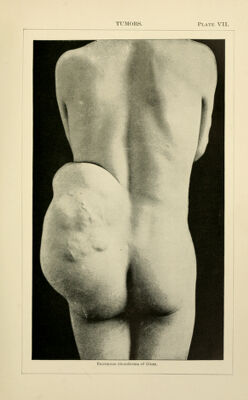
An American text-book of surgery : for practitioners and students / By Phineas S. Conner, M.D., Frederic S. Dennis, M.D., William W. Keen, M.D., Charles B. Nancrede, M.D., Roswell Park, M.D., Lewis S. Pilcher, M.D., Nicholas Senn, M.D., Francis J. Shepherd, M.D., Lewis A. Stimson, M.D., J. Collins Warren, M.D., and J. William White, M.D. Ed. by William W. Keen and J. William White.
- William Williams Keen
- Date:
- 1899
Licence: Public Domain Mark
Credit: An American text-book of surgery : for practitioners and students / By Phineas S. Conner, M.D., Frederic S. Dennis, M.D., William W. Keen, M.D., Charles B. Nancrede, M.D., Roswell Park, M.D., Lewis S. Pilcher, M.D., Nicholas Senn, M.D., Francis J. Shepherd, M.D., Lewis A. Stimson, M.D., J. Collins Warren, M.D., and J. William White, M.D. Ed. by William W. Keen and J. William White. Source: Wellcome Collection.
Provider: This material has been provided by the Augustus C. Long Health Sciences Library at Columbia University and Columbia University Libraries/Information Services, through the Medical Heritage Library. The original may be consulted at the the Augustus C. Long Health Sciences Library at Columbia University and Columbia University.
![B. Tumors conforming to the types of the higher connective tissues: 1. Muscular Tumors, or Myomata.—Only tliose of conjrcnital oriiiin seeiu to be composed of striated innsele-eleineiits (/•/i((b<h)-)/ii/<>)ii<i), hut even in sueli tumors tlie bulk of the neoplasm is not usually composed of muscle-cells. New ijrowtlis made up in part of smooth, iiott-xtriated muscle-cells {Jeio- myoma) fre(iuently occur in the uterus, forminj; such considerable portions of most fibromata of that organ as to induce many writers to term then) myomata of the uterus. In like manner most enlarged prostates are composed in great part of unstriped muscle. Prostatic enlargements are more apt to be due to fibro-myomatous growths involving the whole organ or an entire lobe, altiiough distinct pedunculated growths are not uncommonly found; while those of the uterus, often very large, consist usually of an aggregation of separate tumors. Uterine fibromata also often assume the polypoid form, from the extrusive efforts of the organ excited by the presence of the growth. Situated elsewhere, myomata rarely attain a great bulk. Wherever situated, they grow slowly and are quite innocent, although from their size or position they often cause the utmost inconvenience or even danger to life. They are firm, some- times smooth, but more often nodular, their cut surfaces closely resembling those of a fibrous tumor, owing to the presence of varying quantities of true fibrous tissue; glandular structures form part of prostatic tumors. Diagnosis.—As they are at the outset so situated as to be inaccessible to sight or touch, the reader is referred to the sections on Diseases of the Prostate and the Uterus. When the oesophagus, stomach, or intestines have been the parts aff'ected, the nature of the tumors has rarely been diagnosticated. Treatment.—When accessible, they should be removed. Not seldom this may require total hysterectomy. 2. Vascular or Erectile Tumors, or Angeiomata.—Under this head are classed all neoplasms the chief constituents of which are blood-vessels, either arteries, veins, or capillaries, or in which tlie blood is contained in cav- ernous spaces not true vessels. Many sarcomata, and some fibromata and car- cinomata, are permeated Avith enormous (quantities of blood-vessels or channels of large caliber, but the essential element composing each tumor is not the vascular tissue, but the sarcomatous, fibrous, or carcinomatous element. 3. Both Angeiomata and Lymphangeiomata will be more thoroughly dis- cussed in the chapters on Diseases of the Blood-vessels and Lym])hatics, Avhere their treatment by excision, cauterization, ligature, or electrolysis is described. 4. Nerve Tumors, or Neuromata.—Such growths are of rare occurrence, whether composed of medullated or of non-medullated nerve-fibres. To a void repe- tition, the student is referred to the section on Injuries and Diseases of the Nerves. C. Tumors conforming to the type of embryonic connective tissue. These neoplasms, called Sarcomata (PI. VIII and Fig. 26), closely imi- tate in their structure normal embryonic or immature connective tissue, and to this class belong the fibro-nucleated, fibro-plastic, myeloid, recur- rent fibroid, and many of the encephaloid cancers of the older authors. While normal embryonic connective tissue goes on to the formation of fibrous tissue, cartilage, bone, and so on, the sarcomata always retain the embryonic character at their circumference—/. e. their growing, advancing](https://iiif.wellcomecollection.org/image/b21217014_0246.jp2/full/800%2C/0/default.jpg)