An American text-book of surgery : for practitioners and students / By Phineas S. Conner, M.D., Frederic S. Dennis, M.D., William W. Keen, M.D., Charles B. Nancrede, M.D., Roswell Park, M.D., Lewis S. Pilcher, M.D., Nicholas Senn, M.D., Francis J. Shepherd, M.D., Lewis A. Stimson, M.D., J. Collins Warren, M.D., and J. William White, M.D. Ed. by William W. Keen and J. William White.
- William Williams Keen
- Date:
- 1899
Licence: Public Domain Mark
Credit: An American text-book of surgery : for practitioners and students / By Phineas S. Conner, M.D., Frederic S. Dennis, M.D., William W. Keen, M.D., Charles B. Nancrede, M.D., Roswell Park, M.D., Lewis S. Pilcher, M.D., Nicholas Senn, M.D., Francis J. Shepherd, M.D., Lewis A. Stimson, M.D., J. Collins Warren, M.D., and J. William White, M.D. Ed. by William W. Keen and J. William White. Source: Wellcome Collection.
Provider: This material has been provided by the Augustus C. Long Health Sciences Library at Columbia University and Columbia University Libraries/Information Services, through the Medical Heritage Library. The original may be consulted at the the Augustus C. Long Health Sciences Library at Columbia University and Columbia University.
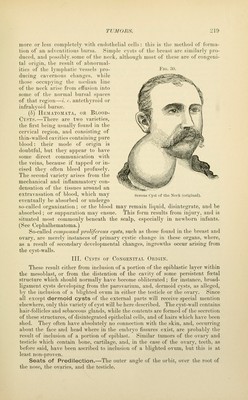
![Serous Cyst of the Neck (original). more or less complctoly witli eiidotliclial cells: this is the method of forma- tion of an adventitious hursa. Sini])le cysts of the hi'cast are siiuihirly pro- duced, and ))ossibly. some of the neck, although most of these are of congeni- tal origin, the result of abnormal- ities of the lymphatic vessels pro- ^^o- 30. ducing cavernous changes. Avhile those occupying the nn-dian line of the neck arise from effusion into some of the normal bursal sj)aces of that region—/. f. antethyroid or infrahyoid bursse. {b) Hkmatomata, or Blood- Cysts.—There are two varieties, the first being usually found in the cervical region, and consisting of thin-walled cavities containing pure blood: their mode of origin is doubtful, but they appear to have some direct communication with the veins, because if tapped or in- cised they often bleed profusely. The second variety arises from the mechanical and inflammatory con- densation of the tissues around an extravasation of blood, which may eventually be absorbed or undergo so-called organization; or the blood may remain liquid, disintegrate, and be absorbed; or suppuration may ensue. This form results from injury, and is situated most commonly beneath the scalp, especially in newborn infants. (See Cephalhematoma.) So-called compound proliferous cysts, such as those found in the breast and ovary, are merely instances of primary cystic change in these organs, Avhere, as a result of secondary developmental changes, ingrowths occur arising from the cyst-walls. III. Cysts of Congenital Origin. These result either from inclusion of a portion of the epiblastic layer within the mesoblast, or from the distention of the cavity of some persistent foetal structure which should normally have become obliterated; for instance, broad- ligament cysts developing from the parovarium, and, dermoid cysts, as alleged, by the inclusion of a blighted ovum in either the testicle or the ovary. Since all except dermoid cysts of the external parts will receive special mention elsew'here, only this variety of cyst Avill be here described. The cyst-wall contains hair-follicles and sebaceous glands, while the contents are formed of the secretion of these structures, of disintegrated epithelial cells, and of hairs Avhich have been shed. They often have absolutely no connection with the skin, and, occurring about the face and head where in the embryo fissures exist, are probably the result of inclusion of a portion of epiblast. Similar tumors of the ovary and testicle which contain bone, cartilage, and, in the case of the ovary, teeth, as before said, have been ascribed to inclusion of a blighted ovum, but this is at least non-proven. Seats of Predilection.—The outer angle of the orbit, over the root of the nose, the ovaries, and the testicle.](https://iiif.wellcomecollection.org/image/b21217014_0279.jp2/full/800%2C/0/default.jpg)