An American text-book of surgery : for practitioners and students / By Phineas S. Conner, M.D., Frederic S. Dennis, M.D., William W. Keen, M.D., Charles B. Nancrede, M.D., Roswell Park, M.D., Lewis S. Pilcher, M.D., Nicholas Senn, M.D., Francis J. Shepherd, M.D., Lewis A. Stimson, M.D., J. Collins Warren, M.D., and J. William White, M.D. Ed. by William W. Keen and J. William White.
- William Williams Keen
- Date:
- 1899
Licence: Public Domain Mark
Credit: An American text-book of surgery : for practitioners and students / By Phineas S. Conner, M.D., Frederic S. Dennis, M.D., William W. Keen, M.D., Charles B. Nancrede, M.D., Roswell Park, M.D., Lewis S. Pilcher, M.D., Nicholas Senn, M.D., Francis J. Shepherd, M.D., Lewis A. Stimson, M.D., J. Collins Warren, M.D., and J. William White, M.D. Ed. by William W. Keen and J. William White. Source: Wellcome Collection.
Provider: This material has been provided by the Augustus C. Long Health Sciences Library at Columbia University and Columbia University Libraries/Information Services, through the Medical Heritage Library. The original may be consulted at the the Augustus C. Long Health Sciences Library at Columbia University and Columbia University.
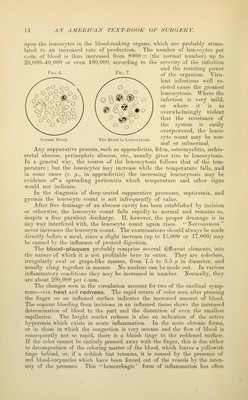
![will detect the elianiiels through wliieh, occasionally, a few hlood-corpnscles pass. At the beginning of the inHaniniatory process the rajiidilif of the fliiiv of blood is iireatli/ iiicrcascd and a greater amount of blood is observed in the part. Tlie Imiuni of the artcn/ is yreater than before, and the column of red corpuscles is much broader and fills a comparatively greater portion of the lumen of the vessel. The capillaries are now quite distinctly seen, and nre crowded with blood-corpuscles. They appear to be considerably larger than they were before. The tlow of blood is also more rapid in the veins, and it is of a brighter and more arterial color. This condition of the circulation is known as Jiypi'vemia (Fig. 2), and is presently succeeded by a slowing of the current, which soon becomes much more ^^•- '^ sluggish than in the normal state. This is first noticed in the capilla- ries, and soon after in the veins. The })ulsation, however, continues in the arteries. As a result of this diminution of speed the column of blood-corpuscles becomes broader, and almost completely fills the in- terior of the vessels. In the veins a great aceuriiulation of tvhite cor- puscles takes place on the interior of the walls. Being of a lower specific gravity than the red cor- puscles, the leucocytes are not forced onward with the same mo- mentum, and are drop])ed, as it were, here and there on the vessel- wall. Finally they are so greatly increased in numbers that the entire Avail of the vessel appears to be lined Avith leucocytes. The Avhite corpuscles also accunmlate in the capillaries, but not to the same extent. In the arterioles these corpuscles cling more readily to the Avail during the diastole, but they are soon swept aAvay again into the blood- current. Another step in the process, beginning concurrently Avith the sloAving of the blood-stream, is the emigration of the leucocijtes from the interior of the veins (diapedesis) (Figs. 3 and 4). Many leucocytes, b}' a change of shape, send out little prolongations of protoplasm into the substance of the Avail, and slight protuberances are soon seen projecting from its outer surface. These enlarge, and Ave noAv see the corpuscles presenting an hour-glass appearance. The por- tions Avithin the vessel soon folloAv those Avithout, and the leucocytes escape from all contact Avith the vessel. Many corpuscles appear to folloAv one another through the same point in the wall. AVhether there are actual holes (stomata) between the endothelial cells of the vessel through Avhich the leucocytes escape or not is still a disputed question. The amoeboid movements of the leuco- cytes are effected by a poAver of those cells to change their shape. Processes (pseudopodia) are throAvn out from the protoplasm of the cell, Avhich noA\' becomes elongated or fiask-shaped. As the ])rotoplasmic mass resumes its more or less globular form, the main portion folloAvs the protruded mass, and stasis of Blood and Diapedesis of White Corpuscles in Inflammation (original).](https://iiif.wellcomecollection.org/image/b21217014_0044.jp2/full/800%2C/0/default.jpg)