An American text-book of surgery : for practitioners and students / By Phineas S. Conner, M.D., Frederic S. Dennis, M.D., William W. Keen, M.D., Charles B. Nancrede, M.D., Roswell Park, M.D., Lewis S. Pilcher, M.D., Nicholas Senn, M.D., Francis J. Shepherd, M.D., Lewis A. Stimson, M.D., J. Collins Warren, M.D., and J. William White, M.D. Ed. by William W. Keen and J. William White.
- William Williams Keen
- Date:
- 1899
Licence: Public Domain Mark
Credit: An American text-book of surgery : for practitioners and students / By Phineas S. Conner, M.D., Frederic S. Dennis, M.D., William W. Keen, M.D., Charles B. Nancrede, M.D., Roswell Park, M.D., Lewis S. Pilcher, M.D., Nicholas Senn, M.D., Francis J. Shepherd, M.D., Lewis A. Stimson, M.D., J. Collins Warren, M.D., and J. William White, M.D. Ed. by William W. Keen and J. William White. Source: Wellcome Collection.
Provider: This material has been provided by the Augustus C. Long Health Sciences Library at Columbia University and Columbia University Libraries/Information Services, through the Medical Heritage Library. The original may be consulted at the the Augustus C. Long Health Sciences Library at Columbia University and Columbia University.
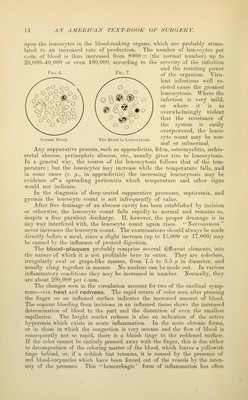
![upon the leucocytes in tlie blood-iuiikinf]; organs, which arc probably stimu- lated to an increased rate of production. The number of leucocytes jier c.cm. of blood is thus increased from HUGO ± (the normal number) up to 20,000-40,000 or even 100,000, according to the severity of the infection and the resisting power ''^*- ^- ^■' '^- of the organism. Viru- lent infections well re- sisted cause the greatest leucocytosis. Where the infection is very mild, or where it is so overwhelmingly violent that the resistance of the system is easily overpowered, the leuco- , T., , rrv. 1,1 , 1 . ■ cyte count may be nor- Normal Blood. The Blood in Leucocvtosis. ^ , , -^ , mal or subnormal. Any suppurative process, such as appendicitis, felon, osteomyelitis, ischio- rectal abscess, perinephric abscess, etc., usually gives rise to leucocytosis. In a general way, the course of the leucocytosis follows that of the tem- perature ; but the leucocytes may increase while the temperature falls, and in some cases {e. ^., in appendicitis) the increasing leucocytosis may be evidence of* a spreading peritonitis which temperature and other signs would not indicate. In the diagnosis of deep-seated suppurative processes, septicemia, and pyemia the leucocyte count is not infre(|uently of value. After free drainage of an abscess cavity has been established by incision or otherwise, the leucocyte count falls rapidly to normal and remains so, despite a free purulent discharge. If, however, the proper drainage is in any Avay interfered with, the leucocyte count again rises. Nervousness never increases the leucocyte count. The examinations should always be made directly before a meal, since a slight increase (up to 15,000 or 17.000) may be caused by the influence of proteid digestion. The blood-plaques probably comprise several different elements, into the nature of Avhich it is not profitable here to enter. They are colorless, irregularly oval or grape-like masses, from 1.5 to 3.5 fx in diameter, and usually cling together in masses. No nucleus can be made out. In various inflammatory conditions they may be increased in number. Normally, they are about 200,000 per c.mm. The changes seen in the circulation account for two of the cardinal symp- toms—viz. heat and redness. The rapid return of color seen after pressing the finger on an inflamed surface indicates the increased amount of blood. The copious bleeding from incisions in an inflamed tissue shows the increased detei'mination of blood to the part and the distention of even the smallest capillaries. The bright scarlet redness is also an indication of the active hyperemia Avhich exists in acute inflammation. In the more chronic forms, or in those in which the congestion is very intense and the flow of blood is consequently not so rapid, there is a bluish tinge to the reddened surface. If the color cannot be entirely pressed away Avith the finger, this is due either to decomposition of the coloring matter of the blood, which leaves a yellowish tinge behind, or, if a reddish tint remains, it is caused by the presence of red blood-corpuscles which have been forced out of the vessels by the inten- sity of the pressure. This hemorrhagic form of inflammation has often](https://iiif.wellcomecollection.org/image/b21217014_0046.jp2/full/800%2C/0/default.jpg)