An American text-book of surgery : for practitioners and students / By Phineas S. Conner, M.D., Frederic S. Dennis, M.D., William W. Keen, M.D., Charles B. Nancrede, M.D., Roswell Park, M.D., Lewis S. Pilcher, M.D., Nicholas Senn, M.D., Francis J. Shepherd, M.D., Lewis A. Stimson, M.D., J. Collins Warren, M.D., and J. William White, M.D. Ed. by William W. Keen and J. William White.
- William Williams Keen
- Date:
- 1899
Licence: Public Domain Mark
Credit: An American text-book of surgery : for practitioners and students / By Phineas S. Conner, M.D., Frederic S. Dennis, M.D., William W. Keen, M.D., Charles B. Nancrede, M.D., Roswell Park, M.D., Lewis S. Pilcher, M.D., Nicholas Senn, M.D., Francis J. Shepherd, M.D., Lewis A. Stimson, M.D., J. Collins Warren, M.D., and J. William White, M.D. Ed. by William W. Keen and J. William White. Source: Wellcome Collection.
Provider: This material has been provided by the Augustus C. Long Health Sciences Library at Columbia University and Columbia University Libraries/Information Services, through the Medical Heritage Library. The original may be consulted at the the Augustus C. Long Health Sciences Library at Columbia University and Columbia University.
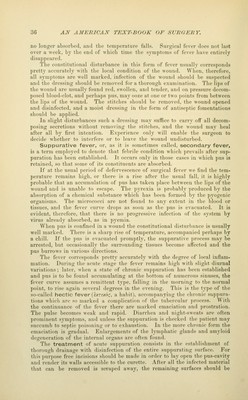
![artery does not terminate abruptly in a cul-de-sac at the point of ]if];ature, but is partially obliterated for some distance from the ligature by a growth from the intima and other coats of the vessel. This compensatory end- arteritis ada])ts the vessel to the greatly diminished blood-suj)ply needed for the stump. After ligature in continuity the branches given off above and below the ligature become enlarged, and, anastomosing with one another, establish a collateral circulation. CHAPTER IV. THE TRAUMATIC FEVERS. The fever which occurs after the infliction of a wound may be aseptic or septic, according to the conditions which prevail at the time of the trauma or injury. Clinically, surgical fevers may be divided into two main groups, the benign and the malignant types of fever. It is the former group only which is considered in this chapter. The benign group includes those forms which are described usually as traumatic fever, and includes aseptic fever, septic or surgical fever, as it was formerly called, and suppurative fever. To these may be added certain special forms, such as surgical scarlet fever and urethral fever. The malignant group comprises septicemia, sapremia, and pyemia.' Sep- ticemia and sapremia may be regarded as malignant types of surgical fever, and pyemia the malignant type of suppurative fever. Aseptic fever is characterized by a pyrexia which accompanies wounds healing by first intention. It was formerly supposed that fever was a symp- FlG. 1«. 1 2 3 4 5 6 7 8 9 10 II 12 13 107° 106° IOS° 104* 103* 102' 101* 100° 99* 98° A y\ /\ 1 / / ^ v ^^ > ^. ,^ ^ Temperature Chart of a case of Aseptic Fever (original). torn necessarily associated with infection of the wound, but after the anti- septic treatment of wounds was perfected it was discovered that many wounds thus treated were accompanied by a considerable rise of temperature, par- 1 See pp. 60 and 63.](https://iiif.wellcomecollection.org/image/b21217014_0068.jp2/full/800%2C/0/default.jpg)