An American text-book of surgery : for practitioners and students / By Phineas S. Conner, M.D., Frederic S. Dennis, M.D., William W. Keen, M.D., Charles B. Nancrede, M.D., Roswell Park, M.D., Lewis S. Pilcher, M.D., Nicholas Senn, M.D., Francis J. Shepherd, M.D., Lewis A. Stimson, M.D., J. Collins Warren, M.D., and J. William White, M.D. Ed. by William W. Keen and J. William White.
- William Williams Keen
- Date:
- 1899
Licence: Public Domain Mark
Credit: An American text-book of surgery : for practitioners and students / By Phineas S. Conner, M.D., Frederic S. Dennis, M.D., William W. Keen, M.D., Charles B. Nancrede, M.D., Roswell Park, M.D., Lewis S. Pilcher, M.D., Nicholas Senn, M.D., Francis J. Shepherd, M.D., Lewis A. Stimson, M.D., J. Collins Warren, M.D., and J. William White, M.D. Ed. by William W. Keen and J. William White. Source: Wellcome Collection.
Provider: This material has been provided by the Augustus C. Long Health Sciences Library at Columbia University and Columbia University Libraries/Information Services, through the Medical Heritage Library. The original may be consulted at the the Augustus C. Long Health Sciences Library at Columbia University and Columbia University.
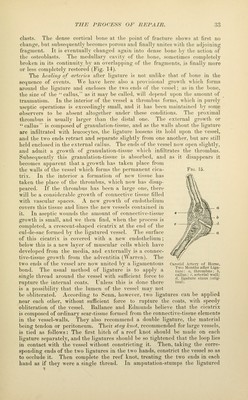
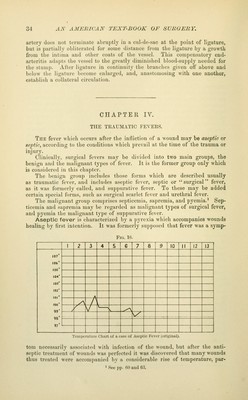
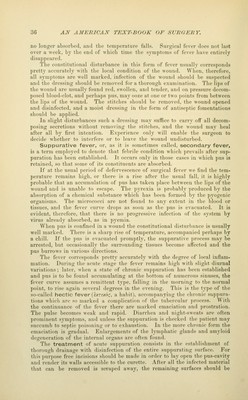
![skin of the back of the neck. Like tlie ])oil, it is at first superficial, ])ut rapidly spreads to the deeper parts. It has erroneously been called a collec- tion of boils, owing to the fact that numerous points of })us a]»))ear on the surface, and when opened it ])resents a honevcond)ed appearance. This peculiarity of the carbuncle is due to the anatomical structure of the skin and subcutaneous tissues of this part of the body. The pus forms in the dense fibrous reticulum -which underlies the thick cutis, and makes its Avay to the surfiice through the columniie adipostc, in which the fine lanugo hairs are situated, causing disintegration of the parts and sloughing of the tissues and the formation of a central crater (Warren). ^Phe carbuncle should be freely incised and all the sloughs removed by the sharp spoon or scissors, and the part disinfected as thoroughly as possible. Complete excision of the car- buncle with thorough disinfection of the parts will often lead to an arrest of the process and a speedy convalescence. Abscess of the lymjjhatic glands may form in the groins, as the result of suppuration complicating venereal disease; in the neck, following inflammation of an adjacent mucous membrane; in the axilla, as the result of suppuration in the fingers or hand; or in the saphenous glands, from suppuration in the toes or foot. A deep abscess of the neck should be opened by Hilton's method. A retropharyngeal ab- scess should be opened through the neck, the incision being made at the anterior or posterior edge of the sterno-cleido-mastoid muscle. Felons and palmar abscesses are often supposed to be caused by direct local trauma, but are more frequently due to indirect infection by pyogenic cocci which probably follows an injury of some kind. The precise seat of the suppura- tion will vary according to the situation of the infection. Nowhere is an early incision of more importance, as the usefulness of the finger or hand is at stake. When abscesses form in and around the internal organs they are usually designated by special names derived from the parts with which they are asso- ciated, as perinephric, psoas, or subdiaphragmatic abscesses. Sub- phrenic abscess, as the latter is sometimes called, is usually due to a circum- scribed peritonitis caused by a perforating ulcer of the stomach, duodenum, or appendix, and more rarely of some other portion of the intestinal tract or to inflammation of the liver, spleen, or kidney. The abscess sometimes contains air and may resemble pyopneumothorax. It may be treated by an intercostal or an abdominal incision (Mason). Abscesses of the liver are occasionally observed in America. They are caused by inflammations in the intestinal tract and contain a brown grumous material, in which is found the amoeba coli {vide infra). Abscess is found in bones near the epiphyseal line ( Brodie's abscess ) in acute inflammation (osteomyelitis), and tuberculous abscesses are often seen near the ends of long bones in connection with joint-disease {vide infra). Abscesses in the brain are occasionally observed as metastatic abscess or in connection with middle-ear suppurations or after injuries. Pus in the thorax is most frequently found in the pleural cavity, consti- tuting empyema. An empyema can rarely be cured by aspiration, but should be promptly opened and drained. A cure may be retarded by the mechanical difficulty of bringing the abscess walls together, owing to the contraction of the lung and the rigidity of the chest Avail. In these cases resection of several ribs is necessary to allow the thoracic wall to come in contact with the lung (Estlander's or Schede's operation). Tuberculosis is often a complication of this variety of suppuration. Abscesses occur also, but much more rarely, in the lung itself. These can be opened and drained](https://iiif.wellcomecollection.org/image/b21217014_0081.jp2/full/800%2C/0/default.jpg)