[Report 1948] / Medical Officer of Health, Manchester City.
- Manchester (England). City Council. n 88637066.
- Date:
- 1948
Licence: Attribution 4.0 International (CC BY 4.0)
Credit: [Report 1948] / Medical Officer of Health, Manchester City. Source: Wellcome Collection.
282/330 page 14
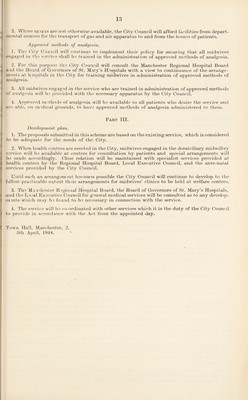
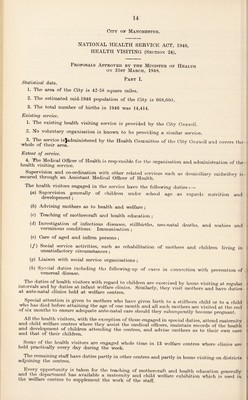
![City of Manchester. NATIONAL HEALTH SERVICE ACT, 1946. HEALTH VISITING (Section 24). Proposals Approved by the Minister of Health on 31st March, 1948. 0 . . Part I. statistical data. 1. The area of the City is 42*58 square miles. 2. The estimated mid-1946 population of the City is 668,660. 3. The total number of births in 1946 was 14,414. Existing service. 1. The existing health visiting service is provided by the City Council. 2. No voluntary organisation is known to be providing a similar service. 3. The service is]administered by the Health Committee of the City Council and covers the whole of their area. Extent of service. 4. The Medical Officer of Health is responsible for the organisation and administration of the health visiting service. Supervision and co-ordination with other related services such as domiciliary midwifrrv is secured through an Assistant Medical Officer of Health. The health visitors engaged in the service have the following duties — (a) Supervision generally of children under school age as regards nutrition and development; (b) Advising mothers as to health and welfare ; (c) Teaching of mothercraft and health education ; (d) Investigation of infectious diseases, stillbirths, neo-natal deaths, and scabies and verminous conditions. Immunisation ; (e) Care of aged and infirm persons ; (/) Social service activities, such as rehabilitation of mothers and children living in unsatisfactory circumstances ; (g) Liaison with social service organisations ; (h) Special duties including the following-up of cases in connection with prevention of venereal disease. Il The duties of health visitors with regard to children are exercised by home visiting at regular g intervals and by duties at infant welfare clinics. Similarly, they visit mothers and have duties at ante-natal clinics held at welfare centres. Special attention is given to mothers who have given birth to a stillborn child or to a child f who has died before attaining the age of one month and all such mothers are visited at the end i of six months to ensure adequate ante-natal care should they subsequently become pregnant. ^llhea^h visitors> with the exception of those engaged in special duties, attend maternity n and child welfare centres where they assist the medical officers, maintain records of the health i and development of children attending the centres, and advise mothers as to their own care and that of their children. Some of the health visitors are engaged whole time in 13 welfare centres where clinics are ir held practically every day during the week. The remaining staff have duties partly in other centres and partly in home visiting on districts : adjoining the centres. Every opportunity is taken for the teaching of mothercraft and health education generally 1 ®'n(^ department has available a maternity and child welfare exhibition which is used in 1 the welfare centres to supplement the work of the staff,](https://iiif.wellcomecollection.org/image/b29785698_0282.jp2/full/800%2C/0/default.jpg)