Preparation and properties of some new tropeines / by H.A.D. Jowett and A.C.O. Hann.
- Jowett, H. A. D. (Hooper Albert Dickinson)
- Date:
- [1906]
Licence: In copyright
Credit: Preparation and properties of some new tropeines / by H.A.D. Jowett and A.C.O. Hann. Source: Wellcome Collection.
6/14 page 360
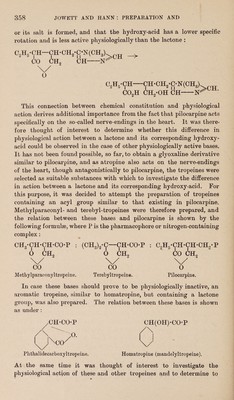
![(1) That the peculiar difference in physiological action between a lactone and its corresponding hydroxy-acid, as exemplified by pilocarpine and pilocarpic acid, also occurs in the case of a tropeine having a haptophore group similar to that in pilocarpine, namely, terebyltropeine, and also in the case of phthalidecarboxyltropeine. (2) That Ladenburg’s generalisation, so far as it refers to the necessity for a mydriatic tropeine to contain a benzene nucleus, does not strictly hold, since terebyltropeine possesses a distinct mydriatic action. It would appear, however, that the conditions most favourable for the development of the mydriatic action in a tropeine are those stated by Ladenburg, namely, that the acyl group should contain a benzene nucleus and an aliphatic hydroxyl in the side-chain containing the carboxyl group. Experimental. Glycollyltropeine, 0 H2(OH)• CO*C8H14ON. This base was made by the general method devised by Ladenburg for the preparation of tropeines (Annalen, 1883, 217, 82), namely, by neutralising tropine with glycollic acid and digesting the resulting solution with dilute hydrochloric acid (1 :40) for twenty-four hours on a water-bath. The crude base was purified by its conversion into the hydriodide and recrystallisation of this salt from methyl alcohol until pure. On regeneration, the base was obtained crystalline and was recrystallised from benzene until the melting point was constant ; it formed laminar crystals melting at 113—114°, which are readily soluble in alcohol, moderately so in water, but dissolve only sparingly in ether. O il gave 0-2436 C02 and 0*0864 H20. 0 = 60-4; H = 8 7. C10HirO3N requires C = 603 ; H = 8*5 per cent. The hydrochloride formed exceedingly deliquescent crystals, which, after drying at 110°, melted at 171—172°. 03644 gave 0*22 AgCl. 01 = 14 9. C]0Hl7O3N,HCl requires Cl= 15*0 per cent. The hydriodide separated from methyl-alcoholic solution in stout, acicular crystals which melted at 187—-188°; it is easily soluble in water, sparingly so in alcohol, and insoluble in ether. The salt contained half a molecule of water of crystallisation, which was not lost after five hours’ heating at 110°, and at a higher temperature it became decomposed.](https://iiif.wellcomecollection.org/image/b30610047_0006.jp2/full/800%2C/0/default.jpg)