Some new gold salts of hyoscine, hyoscyamine and atropine / by H.A.D. Jowett.
- Jowett, H. A. D. (Hooper Albert Dickinson)
- Date:
- [1897.]
Licence: Public Domain Mark
Credit: Some new gold salts of hyoscine, hyoscyamine and atropine / by H.A.D. Jowett. Source: Wellcome Collection.
5/8 (page 681)
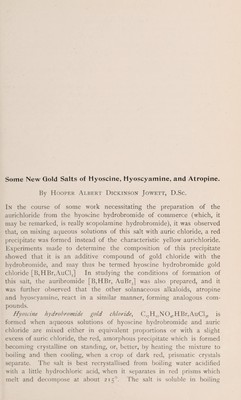
![I'he corresponding salts of hyoscyamine and atropine are prepared in ])recisely the same manner, and possess similar chemical and physical properties. Hyoscyamine hydrobromide gold chloride^ C.7H23N03,HBr, AuClg, is a yellowish-red salt which crystallises from boiling acidified water in scales, melting sharply at 164° (corn) and on analysis was found to contain 28.00 per cent, of gold. Calculated for C,7H23N03,HBr,AUCI3, : All = 27.76 per cent. Hyoscyamine auribromide^ Ci7H23N03,HBr,AuBr3, is prepared by the method described for hyoscine auribromide, and is in appearance exactly similar to that salt. It melts at 115®—120^ (corr.) and is soluble in hot water, but only sparingly in cold water. On analysis, the recrystal¬ lised salt was found to contain 23.75 cent, of gold. Calculated for C,7H23N03,HBr,AuBr3 : Au = 24.3 per cent. Atrophie hydrobromide gold chloride^ Ci7H23N03,HBr,AUCI3. This salt is precipitated as an oil when prepared in the usual manner, but crystallises from boiling acidified water in reddish brown scales, which melt sharply at 144^ (corr.) and contain 27.20 per cent, of gold C,7H23N03, H Br,AuCl3 requires 27.76 per cent. gold. Atropitie auribromide^ C,7H23NO,,H Br,AuBr3.—This salt is also pre¬ cipitated as an oil when prepared in the usual manner, and crystallises from boiling acidified water in chocolate j)risms, similar in appear¬ ance to the other auribromides, and melts at 120® (corr.) On an¬ alysis, it was found to contain 23.6 per cent, of gold. Calculated for (.',,1123X03, H Br,Au Br3 : Au = 24.3 per cent. It will be noticed that the gold chloride compounds have in every case a melting point slightly higher than that of the aurichloride, whilst the auribromides of atropine and hyoscyamine melt at a lower temperature. d'he salts having the composition B,HBr,AuCl3 offer some analogies to a platinum salt first prepared by Pitkin by the interaction of platinic chloride with potassium bromide and to which he ascribed the formula K2PtCl4Br2. It has been stated, however (Herty, J. Am. Chefti. Soc., 1896, 18, 130), that this salt is not a true chemical compound, but an isomorphous mixture of two parts of potassium platinochloride, K2BtCl6, and one part of the platinobromide, IvjPtBr^; this question, however, cannot be regarded as definitely settled (Miolati, Zeii. anorg. Cdiem., 1897, 14, 237). If this view be extended to the gold salts described above, they would have to be regarded as a mixture of three ])arts of the aurichloride with one part of the auribromide. On investigating the matter, however, it appears that these gold salts must be regarded as true chemical comjiounds and not as simple mixtures.](https://iiif.wellcomecollection.org/image/b30594571_0005.jp2/full/800%2C/0/default.jpg)