Elementary text-book of zoology / by C. Claus ; translated and edited by Adam Sedgwick ; with the assistance of F.G. Heathcote.
- Sedgwick Adam.
- Date:
- 1884-1885
Licence: Public Domain Mark
Credit: Elementary text-book of zoology / by C. Claus ; translated and edited by Adam Sedgwick ; with the assistance of F.G. Heathcote. Source: Wellcome Collection.
Provider: This material has been provided by the Royal College of Physicians of Edinburgh. The original may be consulted at the Royal College of Physicians of Edinburgh.
51/982 page 47
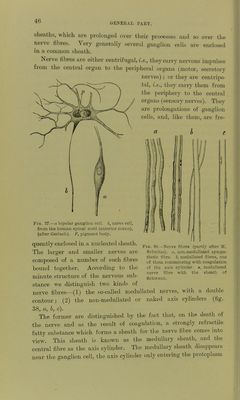
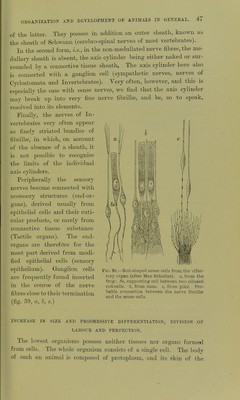
![of the latter. They possess in addition can outer sheath, known as the sheath of Schwann (cerebro-spinal nerves of most vertebrates). In the second form, i.e., in the non-mediillated nerve fibres, the me- dullary sheath is absent, the axis cylinder being either naked or sur- rounded by a connective tissue sheath. The axis cylinder here also is connected with a ganglion cell (sympathetic nerves, nerves of Cyclostomata and Invertebrates). Yery often, however, and this is especially the case with sense nerves, we find that the axis cylinder may break up into very fine nerve fibrillte, and be, so to speak, resolved into its elements. Finally, the nerves of In- vei-tebrates very often appeal- as finely striated bundles of fibrillse,' in which, on account of the absence of a sheath, it is not possible to recognise the limits of the individual axis cylinders. Peripherally the sensory nerves become connected with accessory structures (end-or- gans), derived usually from epithelial cells and their cuti- cular products, or rarely from connective tissue substance (Tactile organs). The end- organs are therefore for the most part derived from modi- fied epithelial cells (sensory epithelium). Ganglion cells are frequently found inserted in the course of the nerve fibres close to their termination (fig. 39, a, I), c.) Fio. 39.—Rod-shaperl sense cells from, the olfac- tory organ (after Max Schultze). a, from the frog-; Sz, sup])orting cell between two ciliated ■ rod-cells, b, from man. c, from pike. Pro- hahle connection between the nerve flbrillse and the sense cells. INCREASE IN SIZE AND PROG'RESSIVE DIFFERENTIATION, DIVISION .OF LABOUR AND PERFECTION. The lowest organisms possess neither tissues nor organs formed from cells. The whole organism consists of a single cell. The body of such an animal is composed of protoplasm, and its skin of the](https://iiif.wellcomecollection.org/image/b21724921_0051.jp2/full/800%2C/0/default.jpg)