On the comparative osteology of the passerine bird Arachnothera magna / by R.W. Shufeldt.
- Robert Wilson Shufeldt
- Date:
- 1909
Licence: In copyright
Credit: On the comparative osteology of the passerine bird Arachnothera magna / by R.W. Shufeldt. Source: Wellcome Collection.
Provider: This material has been provided by The Royal College of Surgeons of England. The original may be consulted at The Royal College of Surgeons of England.
3/22 page 527
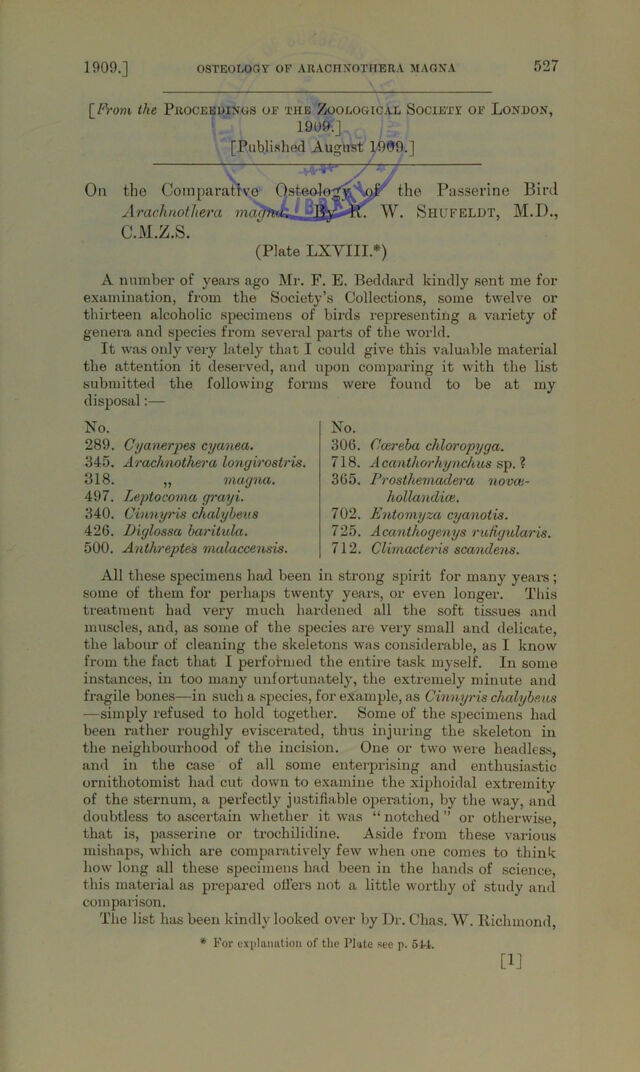
![1909.] \_From the Proceedings of the Zoological Society of London, 1909.] [Published August 19^9.] On the Comparative the Passerine Bird Arachnothera W. Shufeldt, M.D., C.M.Z.S. (Plate LXVIII.*) A number of years ago Mr. F. E. Beddard kindly sent me for examination, from the Society’s Collections, some twelve or thirteen alcoholic specimens of bii'ds representing a variety of genera and species from several parts of the world. It was only very lately that I could give this valuable material the attention it deserved, and upon comparing it with the list submitted the following forms were found to be at my disposal:— No. 289. Cyanerpes cyanea. 345. Arachnothera lonyirostris. 318. ,, may')U(,. 497. Leptocoma grayi. 340. Cinnyris chalybeus 426. Diglossa haritula. 500. Anthreptes malaccensis. No. 306. Coereha chloropyga. 718. Acanthorhynchus sp. ? 365. Prosthemadera novoe- hollandice. 702. Entomyza cyanotis. 725. Acanthogenys ruhgidaris. 712. Climacteris scandens. All these specimens had been in strong spirit for many yeais; some of them for perhaps twenty years, or even longer. This treJitment had very much hardened all the soft tissues and muscles, and, as some of the species are very small and delicate, the labour of cleaning the skeletons was cousidei-able, as I know from the fact that I performed the entire task myself. In some instances, in too many unfortunately, the extremely minute and fragile bones—in such a species, for example, as Cinnyris chalybeus —simply refused to hold together. Some of the specimens had been rather roughly eviscerated, thus injuring the skeleton in the neighbourhood of the incision. One or two were headless, and in the case of all some enterprising and enthusiastic ornithotomist had cut down to examine the xiphoidal extremity of the sternum, a perfectly justifiable operation, by the way, and doubtless to ascertain whether it was “ notched ” or otherwise, that is, passerine or trochilidine. Aside from these various mishaps, which are comparatively few when one comes to think how long all these specimens had been in the hands of science, this material as prej)ared ofifers not a little worthy of study and comparison. The list has been kindly looked over by Dr. Chas. W. Richmond, * For (.'xplamition of the Plate see p. 614. [1]](https://iiif.wellcomecollection.org/image/b22426851_0005.jp2/full/800%2C/0/default.jpg)