Elements of chemistry in which the recent discoveries in the science are included and its doctrines familiarly explained : y John Lee Comstock.
- John Lee Comstock
- Date:
- 1852
Licence: Public Domain Mark
Credit: Elements of chemistry in which the recent discoveries in the science are included and its doctrines familiarly explained : y John Lee Comstock. Source: Wellcome Collection.
Provider: This material has been provided by the Woodruff Health Sciences Center Library at Emory University, through the Medical Heritage Library. The original may be consulted at the Woodruff Health Sciences Center Library, Emory University.
34/438
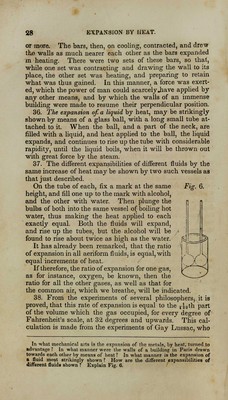
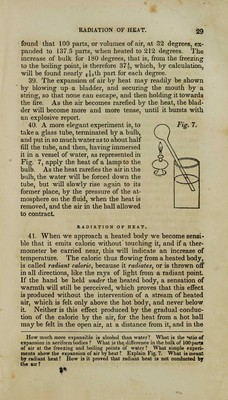
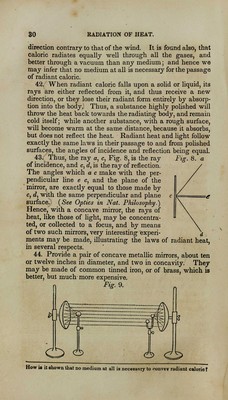
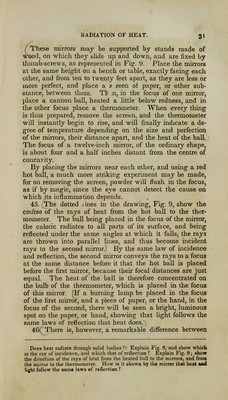
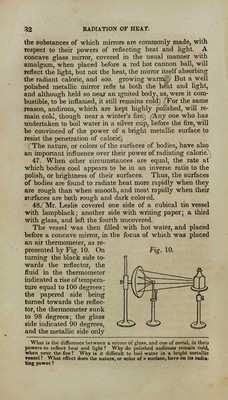
![These mirrors may be supported by stands made of wood, on which they slide up and down, and are fixed by thumb-screws, as represented in Fig. 9. Place the mirrors at the same height on a bench or table, exactly facing each other, and from ten to twenty feet apart, as they are less or more perfect, and place a s reen of paper, or other sub- stance, between them. Th ,n, in the focus of one mirror, place a cannon ball, heated a little below redness, and in the other focus place a thermometer. When every thing is thus prepared, remove the screen, and the thermometer will instantly begin to rise, and will finally indicate a de- gree of temperature depending on the size and perfection of the mirrors, their distance apart, and the heat of the ball. The focus of a twelve-inch mirror, of the ordinary shape, is about four and a half inches distant from the centre of concavity. By placing the mirrors near each other, and using a red hot ball, a much more striking experiment may be made, for on removing the screen, powder will flash in the focus, as if by magic, since the eye cannot detect the cause on which its inflammation depends. 45. The dotted i ines in the drawing, Fig. 9, show the course of the rays of heat from the hot ball to the ther- mometer. The ball being placed in the focus of the mirror, the caloric radiates to all parts of its surface, and being reflected under the same angles at which it falls, the raj? are thrown into parallel lines, and thus become incident rays to the second mirror.] By the same law of incidence and reflection, the second mirror conveys the rays to a focus at the same distance before it that the hot ball is placed before the first mirror, because their focal distances are just equal. The heat of the ball is therefore concentrated on the bulb of the thermometer, which is placed in the focus of this mirror. (If a burning lamp be placed in the focus of the first mirror, and a piece of paper, or the hand, in the focus of the second, there will be seen a bright, luminous spot on the paper, or hand, showing that light follows the same laws of reflection that heat does. 46: There is, however, a remarkable difference between Does heat radiate through solid bodies? Explain Fig. 8, and show which is the ray of incidence, and which that of reflection ? Explain Fig. 9; show the direction of the rays of heat from the heated ball to the mirrors, and from the mirror to the thermometer. How is it shown by the mirror that heat and light follow the same laws ef reflection ?](https://iiif.wellcomecollection.org/image/b21037565_0034.jp2/full/800%2C/0/default.jpg)
 No text description is available for this image
 No text description is available for this image
 No text description is available for this image