A treatise on the blood, inflammation, and gun-shot wounds / by John Hunter ; with notes by James F. Palmer.
- John Hunter
- Date:
- 1840
Licence: Public Domain Mark
Credit: A treatise on the blood, inflammation, and gun-shot wounds / by John Hunter ; with notes by James F. Palmer. Source: Wellcome Collection.
Provider: This material has been provided by the National Library of Medicine (U.S.), through the Medical Heritage Library. The original may be consulted at the National Library of Medicine (U.S.)
33/618
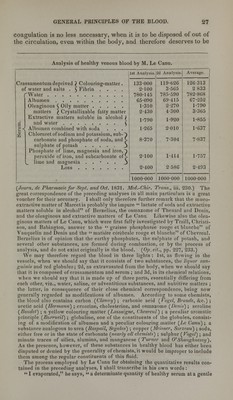
![lation than from its fluidity. The coagulation of the blood, when out of the circulation, would seem to be unconnected with life, yet life could not go on without it; for as all the solid parts of the body are formed from the blood, this could not take place if there did not exist in it the power of coagulating. Many diseases exhibit the blood coagulated in the living body, even in the vessels themselves, but more frequently when extravasated. Coagulation does not be- long to the whole mass of circulating blood, but only to the part I have called coagulating lymph, which during this action commonly detaches itself from the other part, called the serum.* Whether the whole mass of the serum be a distinct part of the blood when circulating is not easily determined, as we have no mode of separating it from the coagulating lymph, while both are fluid. The serum making a part of the whole mass in the fluid state, the first stage in the coagulation is a species of decomposi- tion, forming a separation of the serum. But, on the other hand, there are reasons for considering the coagulating lymph as distinct from the serum, even when both are fluid ; since the serum can be separated from the lymph without coagulating, by many actions of the vessels, both natural, preternatural, or diseased. Thus the liquor of the amnios and that of dropsies are formed; and therefore we may conclude that the separation of the serum, when the lymph is coagulated, is not an act necessary to the coagulation, but an effect of it.f * [This has been doubted by some physiologists, who imagine that the clot essentially consists of the central nuclei of the red globules, deprived of their external investment of colouring matter. (Prevost and Dumas, Jinn, de Chim. et de Phys., xxiii. 51. Young, Med. Lifer.) I do not agree, however, in this opi- nion : first, because there is often a real separation of the coagulable lymph from the red globules previous to these losing their form, and before coagulation ; and, secondly, because Professor Blumenbach was able, by the aid of a common microscope, to discover the red globules entangled in the translucent lymph, and retaining their perfect shape after coagulation. If any separation, such as has been supposed, took place of the colouring matter from the central nuclei, the globules would not be apparent; but the whole would be obscured by a uniform solution of red colouring matter. That the coagulation of the blood arises from the concretion or gelatinization of the fibrin alone is rendered evident by the fact that if fresh-drawn blood be briskly stirred by a wisp, so as to remove this principle from it, the residuary liquor will not coagulate. It may perhaps seem surprising that so small a pro- portion of fibrin as -pnmr should be capable of giving so great a degree of solidity to the whole mass; but in this respect it is nearly equalled by the substance called gelatin, one part of which, dissolved in 100 parts of boiling water, con- cretes into a solid jelly on cooling.] f [Dr. B. G. Babington, in an admirable paper in the Medico-Chirurgical Transactions, vol. xvi., p. 301, has given unanswerable reasons for believing that the serum and coagulable lymph exist in the circulating blood as a homogeneous compound, and not merely in the form of mixture, as has generally been supposed. There is no better reason, he says, for affirming that fibrin exists in a fluid state in liquor sanguinis [the term applied by him to this compound] than for affirming that muriatic acid exists in a solid state in muriate of ammonia. The salt indeed is solid of which the muriatic acid forms one ingredient, but the am- monia is essential to the solidity of the compound. In like manner, the com-](https://iiif.wellcomecollection.org/image/b21131466_0033.jp2/full/800%2C/0/default.jpg)