A treatise on the blood, inflammation, and gun-shot wounds / by John Hunter ; with notes by James F. Palmer.
- John Hunter
- Date:
- 1840
Licence: Public Domain Mark
Credit: A treatise on the blood, inflammation, and gun-shot wounds / by John Hunter ; with notes by James F. Palmer. Source: Wellcome Collection.
Provider: This material has been provided by the National Library of Medicine (U.S.), through the Medical Heritage Library. The original may be consulted at the National Library of Medicine (U.S.)
35/618
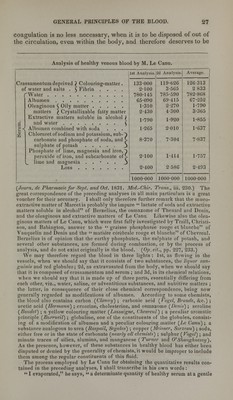
![Blood when extravasated coagulates sooner or later, according to the quickness or slowness of its extravasation, and the quantity extravasated: it coagulates late when drawn into a basin rapidly, and in considerable quantity; soon, when allowed to flow slowly, and in small quantities. This will be better understood when I treat of the principles of coagulation. When blood is received into a cup, and is thereby exposed, it cer- tainly coagulates more readily than when extravasated in the cel- lular membrane or in the vessels; and on the exposed surface it coagulates more readily than anywhere else, except round the edges of the dish in which it is contained. It has been observed that the upper surface of the blood coagulates first, forming a thin pel- licle, as milk does when near boiling, while underneath it still remains fluid ; but the whole gradually becoming thicker, and losing its transparency, coagulates in about fifteen or twenty minutes into a substance of pretty thick consistence. The time required will vary according to the quantity of blood in one mass and the disposition of the blood at the time.* We may observe the following appearances when the blood is coagulated. The coagulum is generally, but not always, swimming in a fluid; for it sometimes happens that the lymph does not squeeze out the serum in the act of coagulation, in which there is an act of contraction. The top of the coagulum is toughest or firmest: and it becomes less and less so towards the bottom, because there is less of the coagulating lymph at the bottom, in proportion as the red globules subside in the lymph before it coagulates. The coagu- lating lymph has a degree of toughness in proportion as it is free from serum ; for while the serum is mixed within it, though there may be no red globules, it is not very tough; but when pressed * [Coagulation commences in about three or four minutes on an average, and is completed in about ten. In about fifteen or twenty minutes the coagulum assumes a pretty thick consistence; but it continues still further to contract and to express the serum for at least three or four hours, and sometimes much longer. The commencement of this process and the degree in which the clot afierwards contracts are subject to be influenced by a great number of disturbing causes: as, for instance, the 6hape and material of the vessel, the state of the system at the time the blood is drawn, the quantity of blood collected together in one mass, the rapidity with which the effusion has taken place, the temper- ature of the air, the partial or complete exclusion of the atmosphere, rest, agita- tion, foreign substances, &c. These will be considered in the subsequent notes. The period required for the blood of different animals to coagulate has been estimated by Thackrah to be, in general terms, inversely as the size of the animal. Thus, in the horse, coagulation commenced in from 5 to 13 minutes; in the ox, from 2 to 10; in the sheep, hog, and rabbit, from \ to 2; in the dog, from |- to 3; in the duck, from 1 to 2 ; in fowls, from \io \\; in the mouse, in a moment. (0/?. cit., p. 154.) There is also a difference in the time required for blood to coagulate from different vessels of the same animal. Arterial blood has generally been conceived to coagulate more rapidly than venous, blood from the vena cava than blood from the jugular vein, and portal blood more readily than either. Thus, while blood from the jugular vein of a dog began to concrete in from 1£ to 3 miuutes, blood from the portal vein concreted immediately on ef- fusion.]](https://iiif.wellcomecollection.org/image/b21131466_0035.jp2/full/800%2C/0/default.jpg)