A treatise on the blood, inflammation, and gun-shot wounds / by John Hunter ; with notes by James F. Palmer.
- John Hunter
- Date:
- 1840
Licence: Public Domain Mark
Credit: A treatise on the blood, inflammation, and gun-shot wounds / by John Hunter ; with notes by James F. Palmer. Source: Wellcome Collection.
Provider: This material has been provided by the National Library of Medicine (U.S.), through the Medical Heritage Library. The original may be consulted at the National Library of Medicine (U.S.)
49/618
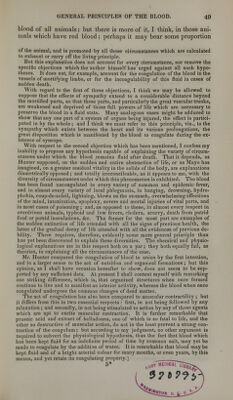
![Besides a disposition for coagulation under certain circumstances, as before described, the blood has also a disposition for the separa- tion of the red globules, and probably of all its parts; for I think I have reason to believe that a disposition for coagulation and a dis- position for a separation of the red part, are not the same thing; but arise from two different principles. Indeed, a disposition to coagu- lation would counteract the effect, and hinder the separation of the red particles from taking place. Thus, we see that rest, or slow motion of the blood in the vessels, gives a disposition towards the separation of the red part, as well as when it is extravasated ; since the blood in the veins of an animal acquires a disposition to separate its red parts more than in the arteries, especially if it be retarded in the veins ; the nearer, therefore, to the heart in the veins the greater will the disposition for separation be, though it does not seem to retard coagulation. This is always observable in bleeding; for if we tie up an arm, and do not bleed immediately, the first blood that flows from the orifice, or that which has stagnated for some time in the veins, will soonest separate into its three constituent parts; this circumstance exposes more of the coagulating lymph at the top, which is supposed by the ignorant to indicate more inflammation, while the next quantity taken suspends its red parts in the lymph, and gives the idea that the first small quantity had been of such service at the time of its flowing as to have altered for the better the whole mass of blood. Rest, therefore, may be regarded as one of the immediate causes of the separation.* traordinary rapidity of the circulatory, secretory, and absorbent functions. A solution of prussiate of potash introduced into the jugular vein of a horse was detected by the appropriate test in the opposite jugular vein in from twenty to thirty seconds, and in the serous cavities of the pericardium and pleura in from two to six minutes; and if we may be allowed to judge from the effects of poisons, or from the rapid manner in which enormous ascitic collections are sometimes suddenly dispersed, the rapidity of the action of the absorbents would appear to exceed even that of the secretories. (Hering in Med. Gazette, xiv. 745.) From these sources it is not difficult to account for the change in quality which the blood undergoes during venesection, which ordinarily occupies from two to five minutes. The first portions of blood which pass are abstracted under natural circumstances; but the new impression which is thus produced on the constitu- tion by the first loss of blood, may easily affect the residual mass; 1st, through the medium of the absorbents; 2d, through the secretory vessels, which rapidly take up the fluid parts of the body, and convey them into the circulation.] * [Buffy Blood.—The reason why more buff appears in the first than in the second quantity of blood (a fact which is by no means universal), will be intelli- gible from what has been said in the preceding note respecting the superabundance of fibrin in inflammatory blood, as well as from the circumstance that the first portions of blood are generally slowest in coagulating, by which a greater time is allowed for the red globules to subside. It is not difficult, however, to prove that an increased disposition to separate must also exist in the red globules, and aid in producing the buffy crust. Take, for example, blood from a patient labouring under acute rheumatism, and set it aside; in less than thirty seconds the surface will be covered with a bluish transparent lymph, although no traces of coagula- tion will be apparent for several minutes afterwards. Thus, Hewson found that of two portions of the same blood, one afforded a buffy crust, and the other none, although the latter remained fluid full ten minutes after the buffy coat had begun 5](https://iiif.wellcomecollection.org/image/b21131466_0049.jp2/full/800%2C/0/default.jpg)