A treatise on the blood, inflammation, and gun-shot wounds / by John Hunter ; with notes by James F. Palmer.
- John Hunter
- Date:
- 1840
Licence: Public Domain Mark
Credit: A treatise on the blood, inflammation, and gun-shot wounds / by John Hunter ; with notes by James F. Palmer. Source: Wellcome Collection.
Provider: This material has been provided by the National Library of Medicine (U.S.), through the Medical Heritage Library. The original may be consulted at the National Library of Medicine (U.S.)
57/618
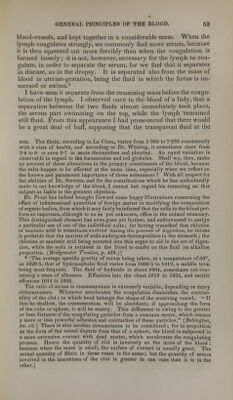
![blood-vessels, and kept together in a considerable mass. When the lymph coagulates strongly, we commonly find more serum, because it is then squeezed out more forcibly than when the coagulation is formed loosely; it is not, however, necessary for the lymph to coa- gulate, in order to separate the serum, for we find that it separates in disease, as in the dropsy. It is separated also from the mass of blood in uterine-gestation, being the fluid in which the foetus is im- mersed or swims.* I have seen it separate from the remaining mass before the coagu- lation of the lymph. I observed once in the blood of a lady, that a separation between the two fluids almost immediately took place, the serous part swimming on the top, while the lymph 'remained still fluid. From this appearance I had pronounced that there would be a great deal of buff, supposing that the transparent fluid at the tem. The fibrin, according to Le Canu, varies from 1-360 to 7-235 consistently with a state of health, and according to Dr. Whiting, it sometimes rises from 2-8 to 6- or even 9-7 in acute rheumatism and pleurisy. An equal variation is observable in regard to the haernatosine and red globules. Shall we, then, make no account of these alterations in the primary constituents of the blood, because the salts happen to be affected at the same time, especially when we reflect on the known and paramount importance of these substances? With all respect for the abilities of Dr. Stevens, and for the contributions which he has undoubtedly made to our knowledge of the blood, I cannot but regard his reasoning on this subject as liable to the greatest objection. Dr. Prout has indeed brought forward some happy illustrations concerning the effect of infinitessimal quantities of foreign matter in modifying the composition of organic bodies, from which it may fairly be inferred that the salts in the blood per- form an important, although to us as yet unknown, office in the animal economy. This distinguished chemist has even gone yet further, and endeavoured to assign a particular use of one of the individual salts; for having remarked that chlorine Or muiidlic acid is Sometimes evolved during the process of digestion, he thinka it probable that the muriate of soda undergoes decomposition in the stomach ; the chlorine or muriatic acid being secreted into this srgan to aid in the act of diges- tion, while the soda is retained in the blood to confer on this fluid its alkaline properties. (Bridgewater Treatise, p. 499.)] * [The average specific gravity of serum being taken, at a temperature of 60°, as 1029-5, that of hydrocephalic fluid varies from 1000-5 to 1019, a middle term being most frequent. The fluid of hydatids is about 1004, sometimes not con- taining a trace of albumen. Effusions into the chest 1019 to 1024, and ascitic effusions 1014 to 1026. The ratio of serum to crassamentum is extremely variable, depending on many circumstances. Whatever accelerates the coagulation diminishes the contrac- tility of the clot; to which head belongs the shape of the receiving vessel. If this be shallow, the crassamentum will be abundant; if approaching the form of the cube or sphere, it will be scanty. This difference is owing to the greater or less distance of the coagulating particles from a common centre, which causes a more or less powerful adhesion and contraction of these particles. (Babington, loc. cit.) There is also another circumstance to be considered ; for in proportion as the form of the vessel departs from that of a sphere, the blood is subjected to a more extensive contact with dead matter, which accelerates the coagulatino- process. Hence the quantity of clot is inversely as the mass of the blood ; because when the mass is small, the surface of contact is usually great. The actual quantity of fibrin in these cases is the same; but the quantity of serum involved in the interstices of the clot is greater in one case than it is in the other.]](https://iiif.wellcomecollection.org/image/b21131466_0057.jp2/full/800%2C/0/default.jpg)