A treatise on the blood, inflammation, and gun-shot wounds / by John Hunter ; with notes by James F. Palmer.
- John Hunter
- Date:
- 1840
Licence: Public Domain Mark
Credit: A treatise on the blood, inflammation, and gun-shot wounds / by John Hunter ; with notes by James F. Palmer. Source: Wellcome Collection.
Provider: This material has been provided by the National Library of Medicine (U.S.), through the Medical Heritage Library. The original may be consulted at the National Library of Medicine (U.S.)
82/618
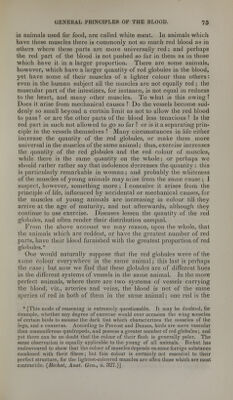
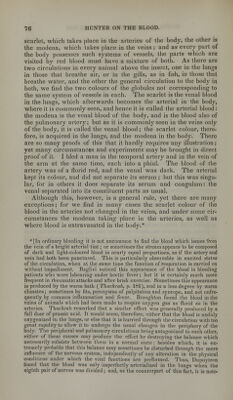
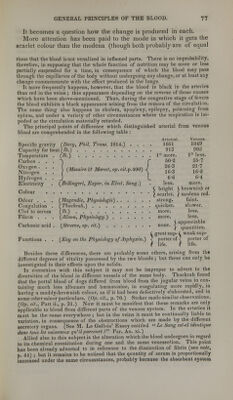
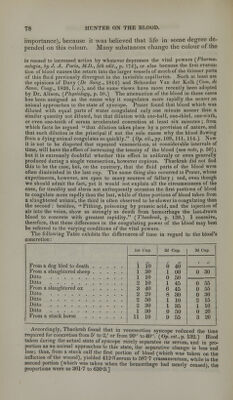
![importance), because it was believed that life in some degree de- pended on this colour. Many substances change the colour of the is roused to increased action by whatever depresses the vital powers (Pharma- cologia, by J. A. Paris, ML)., blh edit., p. 174), or else because the first evacua- tion of blood causes the return into the larger vessels of much of the thinner parts of this fluid previously divergent in the invisible capillaries. Such at least are the opinions of Davy (De Sung., 1814) and Schroeder Van der Kolk {Com. de Sann. Coag., 1820, 1. c), and the same views have more recently been adopted by Dr. Alison, {Physiology, p. 58.) The attenuation of the blood in these cases has been assigned as the cause why it coagulates more rapidly the nearer an animal approaches to the state of syncope. Prater found that blood which was diluted with equal parts of water coagulated only one minute sooner than a similar quantity not diluted, but that dilution with one-half, one-third, one-sixth, or even one-tenth of serum accelerated concretion at least six minutes ; from which facts he argued that dilution takes place by a provision of nature, and that such dilution is the principal if not the sole cause why the blood flowing from a dying animal coagulates so quickly. (Op. cit., pp. 109, 111, 114.) Now it is not to be disputed that repealed venesections, at considerable intervals of time, will have the effect of increasing the tenuity of the blood (see note, p. 50); but it is extremely doubtful whether this effect is uniformly or even generally produced during a single venesection, however copious. Thackrah did not find this to be the case, but, on the contrary, that the fluid parts of the blood were often diminished in the last cup. The same thing also occurred to Prater, whose experiments, however, are open to many sources of fallacy ; and, even though we should admit the fact, yet it would not explain all the circumstances of the case, for timidity and alarm not unfrequently occasion the first portions of blood to coagulate more rapdly than the last, while of three portions of blood taken from a slaughtered animal, the third is often observed to be slower in coagulating than the second : besides, Pithing, poisoning by prussic acid, and the injection of air into the veins, show as strongly as death from hemorrhage the last-drawn blood to concrete with greatest rapidity. (Thackrah, p. 139.) 1 conceive, therefore, that these differences in the coagulating power of the blood may best be referred to the varying conditions of the vital powers. The following Table exhibits the differences of time in regard to the blood's concretion: Ditto ... 1st Cup. 2d Cup. 3d Cup. / il 1 10 1 30 1 10 2 10 3 40 2 29 2 50 2 30 1 30 11 10 / // 0 40 1 00 0 50 1 45 6 45 8 30 1 10 1 35 0 50 9 55 / // 0 30 Ditto , Ditto ... 0 55 0 55 0 30 2 15 1 10 0 20 3 20 Ditto Ditto Accordingly, Thackrah found that in venesection syncope reduced the time required for concretion from 5' to 2/ or from 90 to40. (Op. cit., p. 132.) Blood taken during the actual state of syncope rarely separates its serum, and in pro- portion as an animal approaches to this state, the separative change is less and less; thus, from a stuck calf the first portion of blood (which was taken on the infliction of the wound), yielded 4123 serum to 5877 crassamentum, while in the second portion (which was taken when the hemorrhage had nearly ceased^ the proportions were as 361-7 to 630-3.] ;'](https://iiif.wellcomecollection.org/image/b21131466_0082.jp2/full/800%2C/0/default.jpg)