An estimate of the comparative strength of Britain during the present and four preceding reigns; and of the losses of her trade from every war since the Revolution ... To which is added an essay on population / by the Lord Chief Justice Hale.
- George Chalmers
- Date:
- 1782
Licence: Public Domain Mark
Credit: An estimate of the comparative strength of Britain during the present and four preceding reigns; and of the losses of her trade from every war since the Revolution ... To which is added an essay on population / by the Lord Chief Justice Hale. Source: Wellcome Collection.
154/210 page 140
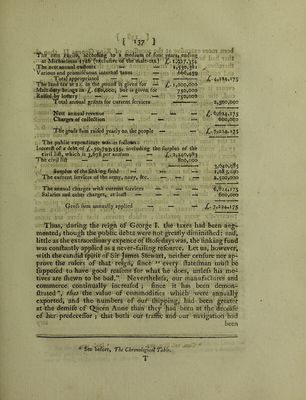
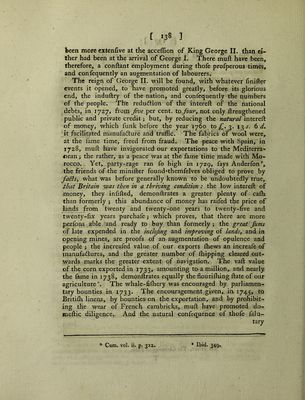
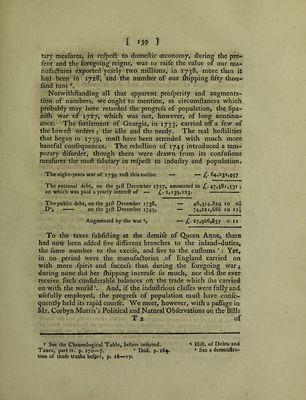
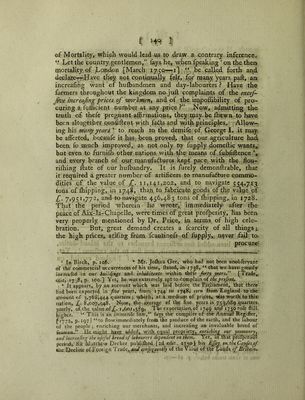
![f !• of Mortality, which would lead us to draw a contrary inference^ Let the country gentlemen,” fays he, when fpeaking' on the therk mortality of London [March i750--i] ** be called forth and declare~Have they i?ot continually felt, for many years paft, an. increafihg want of hufbandmen and day-labourers ? Have the farmers throughout the kingdom no juft complaints of the excej^ Jive increajing prices of workmen^ and of the im,polIibility of pro- curing a fufficient number at any price ?” Now, admitting the truth of thefe pregnant a^rmations, they i^ay. be fhewn to have been altogether conftftent with fadts and w'ith principles. Allow-- ing his many years “ to reach to the demife pf George I. it may be afferted, becaufe it has-been proved, that our agriculture had been fo much improved, as not only to fupply domeftic wants,, but even to furnifh other nations with means of fubiiftence and every branch of our rnanufadlures kept pacci with the flou- rifhing ftate of our hulbandry. It is fiirely demonftrable, that it required a greater number of artificers to manufadture commo- dities of the value of 11,141,202, and to navigate 554,713 tons of (hipping, in 174S, than to fabricate goods of the value of 7»95Ij772, and to navigate 456,483 tons of fbipping, in 1728.. That the period wherein he wrote, immediately after the peace of Aix-la-Chapelle, were times of great profperity, has been very properly mentioned by Dr, Ftice, in terms^ of high cele- bration. But, great demand creates a fcarcity of all things;, the high prices, arifing from fcantinefs of fupp.ly, n§ver fail to. ' procure ‘ In Birch, p. 106. ” Mr. Jofhua Gee, who had not been unobfervant of the commercial occurrences of his time, ftated, in 1738, “ that we have: greatly increafed in our buildings and, inhabitants within th^ie forty, years.'’ [Trade,, edit. 17^.8, p- 100.] Yet, he was extremely apt to complain of * It appears, by .an account which was laid before the Parliament, that there had been exported in five years, from 1744 to 1748, corn from England to the amount of 3,768,444 quarters; which, at a medium of princes, vias worth to this nation, fi. 8,007,948. Now, the average of the five years is 753,689 quarters- yearly, of the value of/. 1,601,589. The exportatioa of 1749 and 1750 rofe ftill. higher. “ This is an i'mmenfe fum,” fays the compiler of the Annual Regilier, [1772, p. 197 J “to flow immediately from the produce of the earth, and the labour of the people ; enriching our merchants, and increafmg an invaluable breed of fearr-pp-” He ought haV£ added, with equal propriety, our yeomanry.^, and increajing the itfieful bread of labourers dependent on them, Yet, inthat pfoTperous period, Sir Matthew Decker publifhed [zd edit. 1750J1 his EJJay^, on. the, Caufies of ihe Decline of Eoreign Trade, and confiequently of the Value of the Lands, of Britain,](https://iiif.wellcomecollection.org/image/b28757671_0154.jp2/full/800%2C/0/default.jpg)