An estimate of the comparative strength of Britain during the present and four preceding reigns; and of the losses of her trade from every war since the Revolution ... To which is added an essay on population / by the Lord Chief Justice Hale.
- George Chalmers
- Date:
- 1782
Licence: Public Domain Mark
Credit: An estimate of the comparative strength of Britain during the present and four preceding reigns; and of the losses of her trade from every war since the Revolution ... To which is added an essay on population / by the Lord Chief Justice Hale. Source: Wellcome Collection.
174/210 page 160
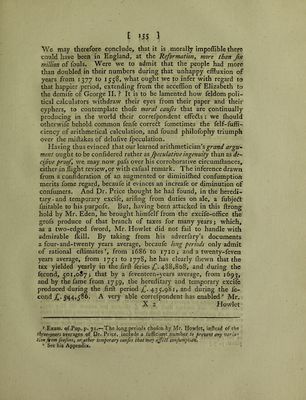
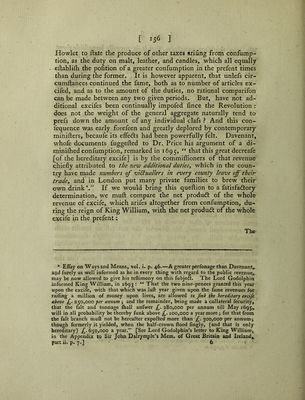
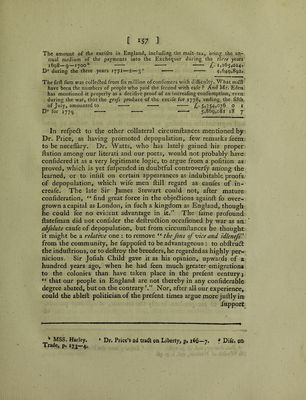
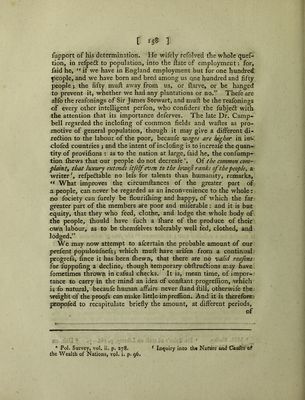
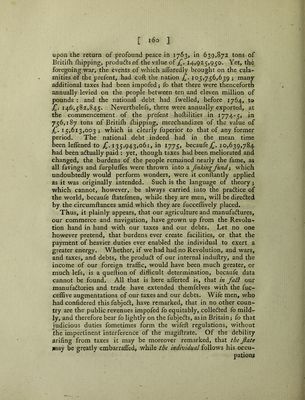
![[ ] upon the return of profound peace in 1763, in 639,872 tons of Britifh fhipping, produ6ls.of the value of I4>925,950. Yet, the foregoing war, the events of which affuredly brought on the cala- mities of the prefent, had coil the nation £. 105,756,639 ; many additional taxes had been impofed; fo that there were thenceforth annually levied on the people between ten and eleven million of pounds : and the national debt had fwelled, before 1764, to 146,582,845. Neverthelefs, there were annually exported, at the commencement of the prefent hoftilities in 1774-5, in 756,187 tons of Britiili /liipping, merchandizes of the value of jT. 15,613,003 ; which is clearly fuperior to that of any former period. The national debt indeed had in the mean time been leffened to 135,943,061, in 1775, becaufe^. 10,639,784 had been actually paid : yet, though taxes had been meliorated and changed, the burdens of the people remained nearly the fame, as all favings and furpluffes were thrown into a Jinking fundi which undoubtedly would perform wonders, were it conftantly applied as it was originally intended. Such is the language of theory j which cannot, however, be always carried into the practice of the world, becaufe ftatefmen, while they are men, will be directed by the circumftances amid which they are fucceflively placed. Thus, it plainly appears, that our agriculture and manufactures, our commerce and navigation, have grown up from the Revolu- tion hand in hand with our taxes and our debts. Let no one however pretend, that burdens ever create facilities, or that the payment of heavier duties ever enabled the individual to exert a greater energy. Whether, if we had had no Revolution, and wars, and taxes, and debts, the produCt of our internal induftry, and the income of our foreign traffic, would have been much greater, or much lefs, is a queftion of difficult determination, becaufe data cannot be found.. All that is here alferted is, that in fa5i our manufactories and trade have extended themfelves with the fuc- ceffive augmentations of our taxes and our debts. Wife men, who had confidered this fubjeCt, have remarked, that in no other coun- try are the public revenues impofed fo equitably, collected fo mild- ly, and therefore bear fo lightly on the fubjeCts, as in Britain j fo that judicious duties fometimes form the wifeft regulations, without the impertinent interference of the magiftrate. Of the debility arhing from taxes it may be moreover remarked, that the fate may be greatly embarraffied, while the individual follows his occu- pation^](https://iiif.wellcomecollection.org/image/b28757671_0174.jp2/full/800%2C/0/default.jpg)