Elements of pharmacy, materia medica, and therapeutics. / By William Whitla.
- William Whitla
- Date:
- 1882
Licence: Public Domain Mark
Credit: Elements of pharmacy, materia medica, and therapeutics. / By William Whitla. Source: Wellcome Collection.
Provider: This material has been provided by The University of Leeds Library. The original may be consulted at The University of Leeds Library.
78/544 page 62
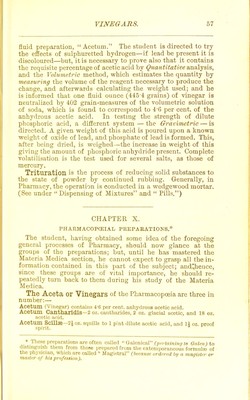
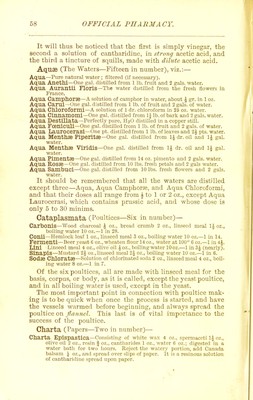
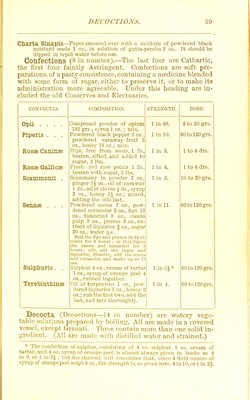
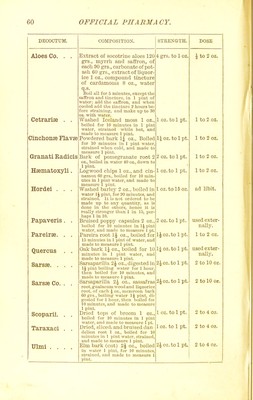
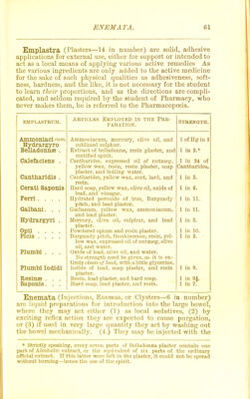
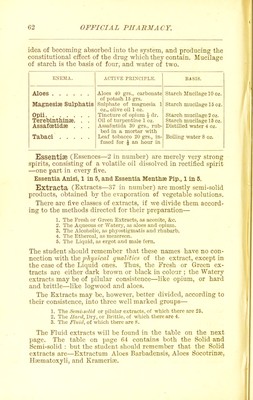
![idea of becoming absorbed into the system, and producing the constitutional effect of the drug which they contain. Mucilage of starch is the basis of four, and water of two. Bj4 sis. Magneslae Sulphatis Opii Terebinthinae. . . Assafoetidse . . . Aloes 40 grs., carbonate of potash 15 grs. Sulphate of magnesia 1 oz., olive oil 1 oz. Tincture of opium \ dr. Oil of turpentine 1 oz. Assafoetida 30 grs., rub- bed in a mortar with Leaf tobacco 20 grs., in- fused for J an hour in Starch Mucilage 10 oz. Starch mucUage 15 oz. Starch mucilage 2 oz. Starch mucilage 15 oz. Distilled water 4 oz. Boiling water 8 oz. Essentise (Essences—2 in number) are merely very strong spirits, consisting of a volatile oil dissolved in rectified spirit —one part in every five. Essentia Anisi, 1 in 5, and Essentia Menthse Pip., lin 6. Extracta (Extracts—37 in number) are mostly semi-solid products, obtained bj' the evaporation of vegetable solutions. There are five classes of extracts, if we divide them accord- ing to the methods directed for their preparation— 1. The Fresh or Green E.^tracts, as aconite, &c. 2. The Aqueous or Watery, as aloes and opimn. 3. The Alcoholic, as pliyostigmatis and rhubarb. 4. The Ethereal, as mezereon. 5. The Liquid, as ergot and male fern. The student should remember that these names have no con- nection with the 7'7(y.?/cffZ qualities of the extract, except in the case of the Liquid ones. Thus, the Fresh or Green ex- tracts are cither dark brown or black in colour ; the Watery extracts may be of pilular consistence—like opium, or hard and brittle—like logwood and aloes. The Extracts may be, however, better divided, according to their consistence, into three well marked groups— 1. The fiemi-snlid or ]iilnliir extracts, of which there are 25. 2. The Ildi cl, Dry, or Brittle, of wliich there are 4. 3. Tlic HuUI, o£ whicli tliere arc 8. The Fluid extracts will be found in the table on the next page. The tabic on jinge M contains both the Solid and Semi-solid : but the student should remember that the Solid extracts are—Extractum Aloes Barbadensis, Aloes Socotrinas, Haimatoxyli, and Kramerire.](https://iiif.wellcomecollection.org/image/b21507296_0078.jp2/full/800%2C/0/default.jpg)