Licence: Public Domain Mark
Credit: The diseases of the stomach / by Dr. C.A. Ewald. Source: Wellcome Collection.
Provider: This material has been provided by the Augustus C. Long Health Sciences Library at Columbia University and Columbia University Libraries/Information Services, through the Medical Heritage Library. The original may be consulted at the the Augustus C. Long Health Sciences Library at Columbia University and Columbia University.
38/634 page 24
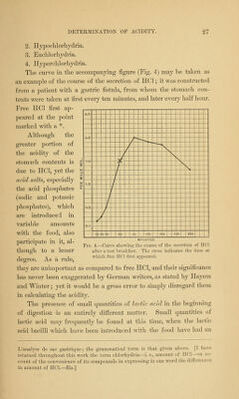
![aniination of the stomacli, and thus the inconveniences of the pro- cedure are reduced to a minimum.* Examination of Stomach Contents.—The filtrate of the stomach contents which is obtained from the test breakfast when digestion is normal, is a clear watery or light to brownish-yellow fluid, which may readily be used for all the various chemical procedures. Upon the filter is left a mushy mass consisting of fine particles of the digested roll, and scarcely any mucus; it should not contain any admixtures, such as old food fragments or blood. At times, when bile has regurgitated into the stomach, the chyme may assume a light-greenish color on standing. If the filtrate contains either the normal or an excessive amount of hydrochloric acid, it will remain as clear as water for days, and during the first few days will scarcely undergo any change in its acidity; but when the amount of hydro- chloric acid is subnormal it soon becomes turbid and moldy. Under ordinary conditions secretion ceases as soon as the chyme has passed into the intestines. The evacuation of the stomach may at times be delayed, and hence the period of secretion may be pro- longed. This condition, however, must be differentiated from that of the continuous secretion of gastric juice, since, during the latter, secretion goes on even when the stomach is empty. Yarious names have been applied to this condition: gasi/PosucGorrhma {Magensaft- fluss) by Eeichmann, hypersecretio acida continua by Jaworski, acute and chronic continuous secretion of gastric juice by Eiegel, while I, for the sake of brevity, simply called it parasecretion [see Chapter XI]. This classification is thus based upon the time, and not the quantity, of the secretion. Hence secretion must not be confounded with acidity; the latter may be normal, increased (su- peracidity), diminished (subacidity), or absent (anacidity). Further- more, the acidity must be distinguished from the percentage of hydrochloric acid, which, as we shall see later on, may vary from an excess {hyperchlorhydria) to an absence of hydrochloric acid {achlorhydria). Determination of Acidity.—The first thing which must be deter- * [It is not advisable to depend upon the results of one examination ; to be at all certain, at least three test meals should be given at different times.—Ed.]](https://iiif.wellcomecollection.org/image/b21223026_0038.jp2/full/800%2C/0/default.jpg)