Licence: Public Domain Mark
Credit: The diseases of the stomach / by Dr. C.A. Ewald. Source: Wellcome Collection.
Provider: This material has been provided by the Augustus C. Long Health Sciences Library at Columbia University and Columbia University Libraries/Information Services, through the Medical Heritage Library. The original may be consulted at the the Augustus C. Long Health Sciences Library at Columbia University and Columbia University.
42/634 page 28
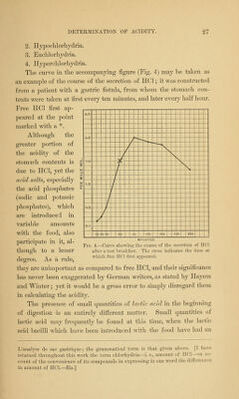
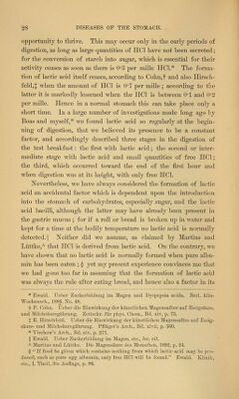
![opportunity to thrive. This may occur only in the early periods of digestion, as long as large quantities of HCl have not been secreted; for the conversion of starch into sugar, which is essential for their activity ceases as soon as there is 0'3 per mille HCL* The forma- tion of lactic acid itself ceases, according to Cohn,f and also Hirsch- feld,:j: when the amount of HCl is 0*7 per mille ; according to the latter it is markedly lessened when the HCl is between O! and 0-2 per mille. Hence in a normal stomach this can take place only a short time. In a large number of investigations made long ago by Boas and myself,* we found lactic acid so regularly at the begin- ning of digestion, that we believed its presence to be a constant factor, and accordingly described three stages in the digestion of the test breakfast: the first with lactic acid; the second or inter- mediate stage with lactic acid and small quantities of free HCl; the third, which occurred toward the end of the first hour and when digestion was at its height, with only free HCL l^evertheless, we have always considered the formation of lactic acid an accidental factor which is dependent upon the introduction into the stomach of carbohydrates, especially sugar, and the lactic acid bacilli, although the latter may have already been present in the gastric mucus ; for if a roll or bread is broken up in water and kept for a time at the bodily temperature no lactic acid is normally detected.!! ]^either did we assume, as claimed by Martins and Luttke,^ that HCl is derived from lactic acid. On the contrary, we have shown that no lactic acid is normally formed when pure albu- min has been eaten ; ^ yet my present experience convinces me that we had gone too far in assuming that the formation of lactic acid was always the rule after eating bread, and hence also a factor in its * Ewald. Ueber Znckerbilduiig im Magen und Dyspepsia acida. Berl. klin- Wochensch., 1886, No. 48. f P. Cohn. Ueber die Einwirkung der kiinstlichen Magensaftes auf Essigsaiire. und Milehsauregahrung. Zeitschr. fiir phys. Chera., Bd. xiv, p. 75. 1^. E. Hirsehfeld. Ueber die Einwirkung der kiinstlichen Magensaftes auf Essig- saure- und Milehsauregahrung. Pfliiger's Arch., Bd. xlvii, p. 5G0. * Virchow's Arch., Bd. civ, p. 271. II Ewald. Ueber Zuckerbildung im Magen, etc., loc. cit. ^ Martins und Lilttke. Die Magensaure des Menschen, 1892, p. 24. () If food be given which contains nothing from which lactic acid may be pro- duced, such as pure egg albumin, only free HCl will be found. Ewald. Klinil:, etc., I. Theil, 3te Aufiage, p. 86.](https://iiif.wellcomecollection.org/image/b21223026_0042.jp2/full/800%2C/0/default.jpg)