Licence: Public Domain Mark
Credit: The diseases of the stomach / by Dr. C.A. Ewald. Source: Wellcome Collection.
Provider: This material has been provided by the Augustus C. Long Health Sciences Library at Columbia University and Columbia University Libraries/Information Services, through the Medical Heritage Library. The original may be consulted at the the Augustus C. Long Health Sciences Library at Columbia University and Columbia University.
46/634 page 32
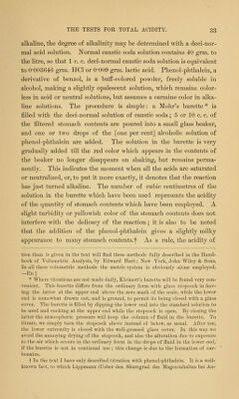
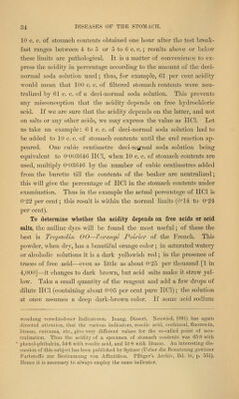
![in comparing different cases. In order to draw general conclusions from a number of details—and it is our task to deduce general laws from the mass of confusing details—it is of no value to know in each individual case the total amount of secretion, which varies every minute ; on the con- trary, it is much more important to know the relation of the case in point to some absolutely fixed standard of comparison. If the grade of a street or railroad is 15 per cent, the relation to all other roads is known, no mat- ter what the absolute length, elevation above the sea. level, etc., may be. The results of the very numerous examinations which have been made in the past have convinced me that percentage values remain uniform when the conditions are unchanged, or, to put it in other words, they change in a corresponding manner. They may therefore be employed in estimating the functional powers of the stomach. A priori, it is evident that the percentage value and the absolute amount of the secretion neither can nor must always agree, since both factors are entirely differently in- fluenced by absorption, transudation, emptying of the stomach, etc. Nat- urally the absolute amount of HCl will vary with the quantity of the chyme; and also, as I have shown elsewhere,* it may happen that the percentage will remain uniform while the total amount of HCl will vary from minute to minute on account of the evacuation of large quan- tities of chyme into the intestines. Hence from moment to moment dur- ing the course of digestion varying absolute values would be obtained which bear no direct or absolute relation to the total quantity secreted by the mucous membrane. Consequently the determination of normal and pathological conditions would be made much more difficult, instead of being simplified. Our knowledge of gastric disorders has been much advanced, and is dependent upon the estimations by percentages; while on the other hand, so far as I know, no new diagnostic facts have been gained by the other method. It is therefore advisable to adhere to the old procedures, and the more so because the method of Geigel and Blass is so complicated as to be useless for practical purposes. However, it is not denied that it may be of some interest to know the absolute amount of secretion at any given moment. [These remarks may also be applied to the various methods f which have been suggested to determine the absolute quantity of stomach contents at the time of their withdrawal. These proce- dures are all too complicated for clinical use, nor are the practical results obtained worth the trouble.] Titration :j: is most conveniently performed with a deci-normal solution of caustic soda, the end reaction being determined with phenol-phthalein. Should the reaction of the stomach contents be * Ewald. Zeitschr. fiir klin. Med., Bd. xx, Heft 4r-Q. f [They are described in Boas, loc. cit., Bd. i, p. 139. Riegel. Erkrankungen des Magens. Nothnagel's Encyclopiedia, 1896, Bd. xvi, II. Theil, p. 88.—Ed.] X [The description of the technique of titration and other strictly chemical pro- cedures lies beyond the province of this work. Those who desire further informa-](https://iiif.wellcomecollection.org/image/b21223026_0046.jp2/full/800%2C/0/default.jpg)