Licence: Public Domain Mark
Credit: The diseases of the stomach / by Dr. C.A. Ewald. Source: Wellcome Collection.
Provider: This material has been provided by the Augustus C. Long Health Sciences Library at Columbia University and Columbia University Libraries/Information Services, through the Medical Heritage Library. The original may be consulted at the the Augustus C. Long Health Sciences Library at Columbia University and Columbia University.
49/634 page 35
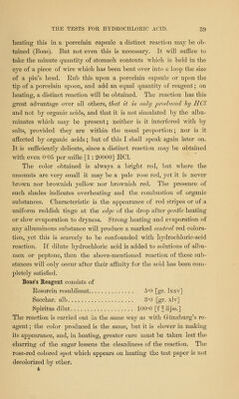
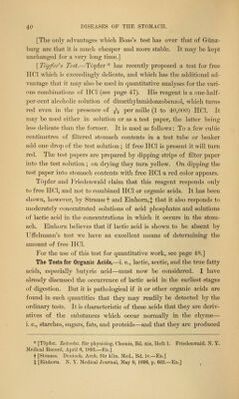
![pLiosphate is added to the tropseolin solution, the color turns not brown, but a light straw yellow. When free acid and acid salts are both present, a turbid, dirty brown color will be obtained according to which of these predominates. Thus tropaeolin enables us to de- termine whether free acids (hydrochloric or lactic) are present. The dye called Congo red, which was introduced by Hoesslin,* has a similar action ; its solutions assume a peach to a brownish-red color. The addition of a free acid changes it to a sky blue. It is more delicate than tropseolin, and will react to a fluid containing but 0'02 per thousand. Acid salts produce no change. Methyl violet is another dye which may be mentioned; it is used in an aqueous solution, which is diluted till it has a reddish-violet color. The addition of even 0*024 per cent of HCl to the solution changes the tint to a sky blue, which is a different color than the original, as can readily be determined when both tubes, before and after adding the stomach contents, are held up to the light. In these tests, as well as in all the other reactions to be mentioned later, there must be an excess of the fluid to be tested over the color solution, otherwise delicate changes might escape notice. The best method is to pour 5 to 10 drops of the color solution into a small test tube and then add 1 to 2 c. c. [15 to 30 drops] of the fil- tered stomach contents. We may also pour a little of the dye upon a white porcelain capsule, spread it out in a thin layer by shaking the capsule from side to side, and then add a few drops of the fil- trate at the edge of the layer. [The color reaction will then be seen at the place of contact.] Or we may dip ordinary filter paper into a solution of the dye. allow it to dry, and cut it uj) into narrow strips. [A strip is dipped into the specimen of stomach contents; the moistened place will then assmne the characteristic color. Such test papers may be also prepared with many of the dyes to be men- tioned later on. This is the most convenient way of employing these tests.] These are all merely modifications of the same thing. It is to be observed that the test papers are somewhat less delicate than the freshly prepared solutions, and they become even less delicate after they have been kept for some time. Thus Boas and * Von Hoesslin. Ein neues Reagent auf freie Sauren. Miinch. med. Wochen- schr., No, 6, 1886.](https://iiif.wellcomecollection.org/image/b21223026_0049.jp2/full/800%2C/0/default.jpg)