The satires of Juvenal / translated and illustrated by Francis Hodgson.
- Juvenal
- Date:
- 1807
Licence: Public Domain Mark
Credit: The satires of Juvenal / translated and illustrated by Francis Hodgson. Source: Wellcome Collection.
Provider: This material has been provided by Royal College of Physicians, London. The original may be consulted at Royal College of Physicians, London.
587/634 page 533
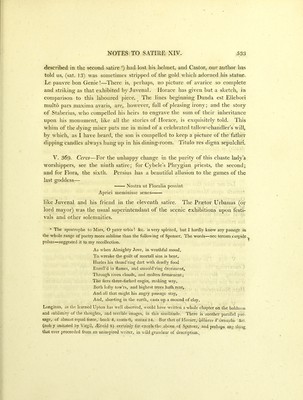
![described in the second satire had lost his liehnet, and Castor, our author has told us, (sat. ] 3) was sometimes stripjjed of the gold which adorned his statue. Le pauvre bon Genie!—There is, perhaps, no picture of avarice so complete and striking as that exhibited by Juvenal. Horace has given but a sketch, in comparison to this laboured piece. ^ The lines beginning Danda est Ellebori multb pars maxima avails, are, however, full of pleasing irony; and the story of Staberius, who compelled his heirs to engrave the sum of their inheritance upon his monument, like all the stories of Horace, is exquisitely told. This whim of the dying miser puts me in mind of a celebrated tallow-chandler’s will, by which, as I have heard, the son is compelled to keep a picture of the father dipping candles always hung up in his dining-room. Titulo res digna sepulchri. V. 369- Ceres^—For the unhappy change in the purity of this chaste lady’s worshippers, see the ninth satire; for Cybele’s Phrygian priests, the second; and for Flora, the sixth. Persius has a beautiful allusion to the games of the last goddess— Nostra ut Floralia possint Aprici meminisse senes like Juvenal and his friend in the eleventh satire. The Prtetor Urbanus (or lord mayor) was the usual superintendant of the scenic exhibitions upon festi- vals and other solemnities. “ The apostrophe to Mars, O pater urbis ! &c. is very spirited, but I hardly know any passage in the whole range of poetry more sublime than the following of Spenser. The words—nec terram cuspide pulsas—suggested it to my recollection. As when Almighty Jove, in wratliful mood. To wreake the guilt of mortall sins is bent, Hurles his thund’ring dart with deadly food Enroll’d in flames, and smould’ring dreriment. Through riven clouds,, and molten firmamentj The fiers three-forked engirr, making way. Both lofty tow’rs, and highest trees hath rent> And. all that might his angry passage stay. And, shooting in the earth, casts up a mound of clay. Longinus, as the learned Upton has vrell observed, would have written a whole chapter on the boldne^ and sublimity of the thoughts, and terrible images, in this similitude. There is another parallel jras- sage, of almost equal force, book 4, canto 6, stanza 14. But that of Homer-, ■ h' tVevssSsv &c. (nob y imitated by Virgil, Ailneid 8) certainly far excels the above of Spenser, and perhaps any tlrin,g that ever proceeded from an uninspired writer, in wild grandeur of description..](https://iiif.wellcomecollection.org/image/b28269743_0591.jp2/full/800%2C/0/default.jpg)