The satires of Juvenal / translated and illustrated by Francis Hodgson.
- Juvenal
- Date:
- 1807
Licence: Public Domain Mark
Credit: The satires of Juvenal / translated and illustrated by Francis Hodgson. Source: Wellcome Collection.
Provider: This material has been provided by Royal College of Physicians, London. The original may be consulted at Royal College of Physicians, London.
615/634 page 561
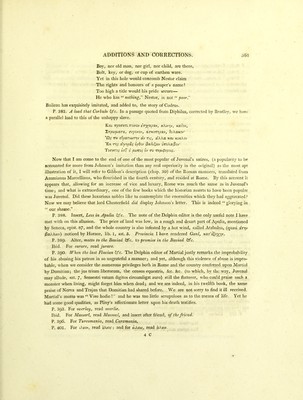
![Boy, nor old man, nor girl, nor child, are there. Bolt, key, or dog, or cup of earthen ware. Yet in this hole would coxcomb Nestor claim The rights and honours of a pauper’s name! Too high a title would his pride secure— He who has nothing, Nestor, is not “ poor. Boileau has exquisitely imitated, and added to, the story of Codrus. P. 382. A load that Corlulo iffc. In a passage quoted from Diphilus, corrected by Bentley, we have a parallel load to this of the unhappy slave. Kai ifpoasri roivw etry^ctpxv, kKivy/v, xxoov, ZrpwjU.ara, ciywov, do'y.OTfijpav, fiuAaxov 'H; ttb xlpxTmrrjV aV rig, a’AXa xai xuxAsv ’Ex rijf dyopoig op^ov (SaSii^siy infoXa^ov Tocrarog erf d punfog dv av 'rrspipspsig, t Now that I am come to the end of one of the most popular of Juvenal’s satires, (a popularity to be accounted for more from Johnson’s imitation than any real superiority in the original) as the most apt illustration of it, I will refer to Gibbon’s description (chap. 30) of the Roman manners, translated from Ammianus Marcellinus, who flourished in the fourth century, and resided at Rome. By this account it appears that, allowing for an increase of vice and luxury, Rome was much the same as in Juvenal’s time; and what is extraordinary, one of the few books which the historian asserts to have been popular was Juvenal. Did these luxurious nobles like to contemplate the enormities which they had aggravated? Now we may believe that lord Chesterfield did display Johnson’s letter. This is indeed “ glorying in ” our shame.” P. 368. Insert, Less in Apulia fe'c. The note of the Delphin editor is the only useful note I have met with on this allusion. The price of land was low, in a rough and desart part of Apulia, mentioned by Seneca, epist. 87, and the whole country is also infested by a hot wind, called Atabulus, (quasi drt]v /SaAAcuv) noticed by Horace, lib. 1, sat. 5. Provincia I have rendered Gaul, Kxr's^oyrjv. P. 389. Alter, motto to the Baviad ilfc. to promise in the Baviad isfc. Ibid. For surare, read jurare. P. 3Q0. When the last Flavian bfc. The Delphin editor of Martial justly remarks the improbability of his abusing his patron in so ungrateful a manner; and yet, although this violence of abuse is impro- bable, when we consider the numerous privileges both in Rome and the country conferred upon Martial by Domitian; the jus trium liberorum, the census equestris, See. &c. (to which, by the way, Juvenal may allude, sat. 7, Semestri vatum digitos circumligat auro) still the flatterer, who could praise such a monster when living, might forget him when dead; and we sea indeed, in his twelfth book, the same praise of Nerva and Trajan that Domitian had shared before. We are not sorry to find it ill received. Martial’s motto was Vive hodie !” and he was too little scrupulous as to the means of life. Yet he had some good qualities, as Pliny’s affectionate letter upon his death testifies. P. 393. For overlay, read overlie. Ibid. For Massort, read Massovt, and insert after friend, of the friend. P. 396. For Turcomania, read Caramania. P. 401. For iXiov, read \Xeog; and for itXetv, read eiXscv.](https://iiif.wellcomecollection.org/image/b28269743_0619.jp2/full/800%2C/0/default.jpg)