Copy 1, Volume 1
The history and antiquities of the Doric race, / by C.O. Müller, ... ; Translated from the German by Henry Tufnell, Esq. and George Cornewall Lewis, Esq.
- Karl Otfried Müller
- Date:
- MDCCCXXX. [1830]
Licence: Public Domain Mark
Credit: The history and antiquities of the Doric race, / by C.O. Müller, ... ; Translated from the German by Henry Tufnell, Esq. and George Cornewall Lewis, Esq. Source: Wellcome Collection.
82/602 page 36
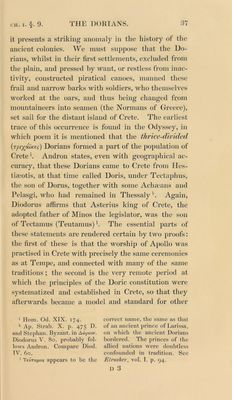
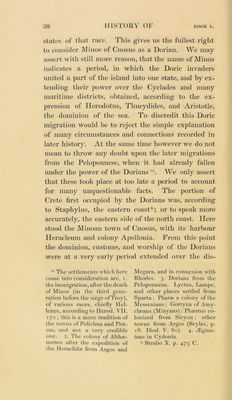
![tioiied into three parts. An exainiiiatioii of the opinion, that the first race was distinguished from the other two as of different origin, will be found in a following chapter We must also refer our reader to the investigation of the worship of Apollo and the mythology of Hercules, in the second book, since from these alone can be collected the internal history of the Doric race during its earliest period. 9. One event which, even if it had not been noticed by tradition, would still have been felt and recognised from the effects it j^roduced, is the migration of the Dorians from the district of mount Olympus to Crete. It is indeed a wonderful migration, being from one end of the Grecian world to tlie other, and ‘EXXrjviKa edurj rfj Kp^Tfj eTTcoKrjaav, IlfXao-yoi, ’A^aiot, Acopuls. The last words must be considered as a mere ignorant addition ; for the Dorians did not divide their territory into three parts, because two other Greek races went to Crete. It is indeed evident that a threefold divi- sion of the land conquered by the Dorians, is here spoken of, which, as is plain from the fa- bles concerning ^Egimius and Hercules, took place according to the three tribes. According to the present reading, this di- vision took place at a distance from the native country of the Dorians, There might seem some difficulty in this, since Hercules is said to have given -(Tgimius the third part of the territory as a TTapaKaTaBrjKTj in Hestiaiotis, the most ancient IV. 37. compare A])()l]odorus II. 7. 3.). Hence TraTpps for Trdrprjs might be read in this sense; “The Dorians divided “ their territory into three “ parts for the families (of “ which the c^ivXai or tribes “ consisted),” so that they then dwelt separately from one an- other (similarly Pindar Olymp. VII. 74). Tliis alteration how- ever appears to be ungramma- tical ; and the old reading is defended by the following ex- planation ; viz. that according to the ancient fable Hyllus and his descendants did not dwell either near mount CEta, or in Hestiseotis together with the Dorians, but that they first re- ceived in the Peloponnese the third part of the territory, whi- ther they came as colonists at a distance from tlieir more an- cient abodes (oca? narpijs).](https://iiif.wellcomecollection.org/image/b28753999_0001_0082.jp2/full/800%2C/0/default.jpg)
 No text description is available for this image
 No text description is available for this image
 No text description is available for this image