Licence: Public Domain Mark
Credit: The Barber-Surgeons of London, by Sidney Young. Source: Wellcome Collection.
Provider: This material has been provided by The Royal College of Surgeons of England. The original may be consulted at The Royal College of Surgeons of England.
7/11 page 101
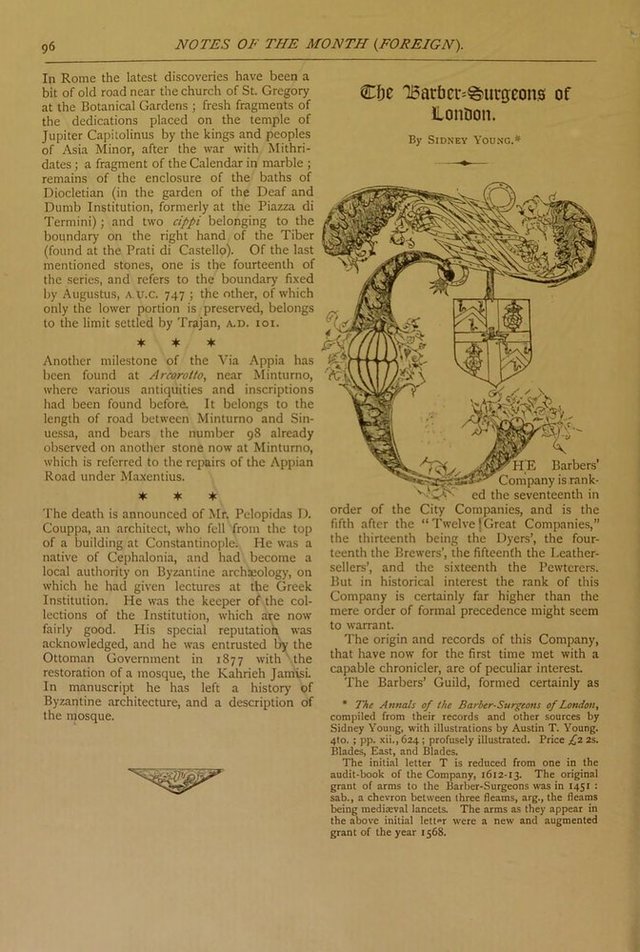
![warden’s being green, and the others crimson. The engraving represents the garland of the renter-warden. The two silver maces pertaining to the beadle of the Barber-Surgeons, an annually elected official who resides at the hall, are as handsome and massive as any in the City, and are carried before the Master on court- days. The Company is much to be congratulated upon having found so painstaking and excel- lent an annalist as Mr. Sidney Young to com- pile their history, and to describe their charters, minutes, and other valuable posses- sions ; and Mr. Sidney Young is fortunate in having so capable a draughtsman as his son, Mr. Austin Young, by whom the majority of the illustrations of this handsome volume have been delineated. The names of the publishers and printers (Blades, East and Blades) are sufficient guarantee for the superior character of all that pertains to the typography of the work. ajQells: tfjeit legentis ann ^uper.5tition,s. By R. C. Hope, F.S.A., F.R.S.L. {Continuedfrom p. 69, vol. xxii.) SHROPSHIRE {continued). BOM ERE POOL. “F^^^OME two centuries ago, or less, a party of gentlemen, including the Squire [of Condover], were fish- ing in the pool, when an enormous fish was captured and hauled into the boat. Some discussion arose as to the girth of the fish, and a bet was made that he was bigger round than the squire, and that the sword- belt of the latter would not reach his waist. To decide the bet the squire unbuckled his belt, which was there and then with some difficulty fastened round the body of the fish. The scaly knight (for so he no doubt felt himself to be) being girt with the sword, began to feel impatient at being kept so long out of his native element, and after divers struggles he succeeded in eluding his captors, and regaining at the same time his freedom and his watery home, carrying the squire’s sword with him.”—Miss C. S. Burne’s Shropshire Folk-lore, p. 81. The Monster Fish of Bomere Pool is thus described: He of course lives in the mere, not beneath it like the water-witches. He is bigger than any fish that ever swam, he wears a sword by his side, and no man can catch him. It was tried once. A great net was brought, and he was entangled in it and brought nearly to the side, but he drew his sword and cut the net and escaped. Then the fishermen made a net of iron links and caught him in that. This time he was fairly brought to land, but again he freed himself with his wonderful sword, and slid back into the water and got away. The people were so terrified at the strange sight that they have never tried to take him again, though he has often been seen since, basking in the shallow parts of the pool with the sword still girded round him. One day, however, he will give it up, but not until the right heir of Condover Hall shall come and take it from him. He will yield it easily then, but no one else can take it. For it is no other than Wild Edric’s sword, which was committed to the fish’s keeping when he vanished, and will never be restored except to his lawful heir. Wild Edric, they say, was born at Condover Hall, and it ought to belong to his family now; but his children were defrauded of their inheri- tance, and that is why there is no luck about the Hall to this day. This curse has been on it ever since then. Every time the pro- perty changes hands the new landlord will never receive the rents twice ; and those who have studied history will tell you that this has always come to pass.—Ibid., p. 80. “ Many years ago, a village stood in the hollow which is now filled up by the mere. But the inhabitants were a wicked race, who mocked at God and His priest. They turned back to the idolatrous practices of their fathers, and worshipped Thor and Woden ; they scorned to bend the knee, save in mockery, to the White Christ who had died to save their souls. The old priest earnestly warned them that God would punish such wickedness as theirs by some sudden judg- ment, but they laughed him to scorn. They](https://iiif.wellcomecollection.org/image/b22433600_0009.jp2/full/800%2C/0/default.jpg)



 No text description is available for this image
 No text description is available for this image
 No text description is available for this image